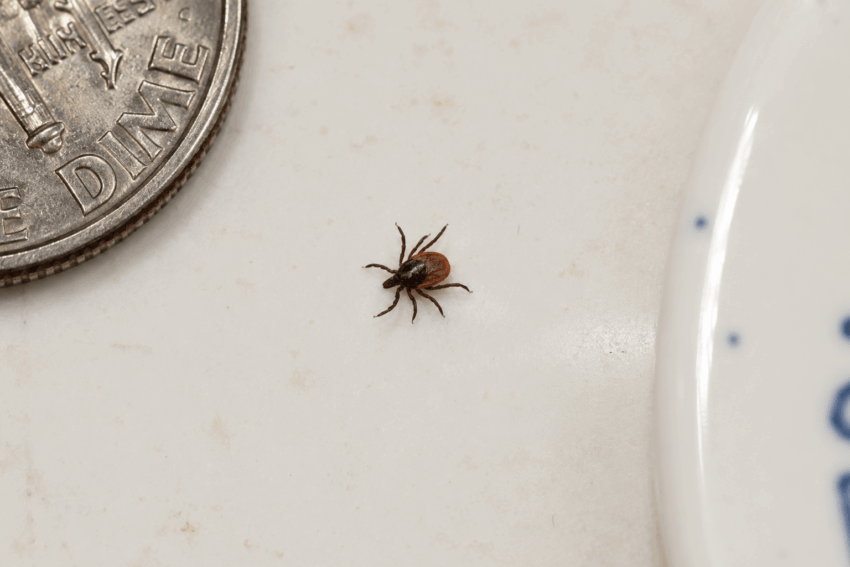
Two ticks. Kitchen floor. Tuesday morning.
Not outside where they belong — where you expect the occasional wildlife cameo after a hike or yard work — but inside, crawling across the linoleum like they paid rent. First time that’s ever happened in this house. First time I’ve had to wonder if ticks are the new spiders-you-eat-in-your-sleep statistic. You know, the one Progressive insurance commercials swear is eight spiders per year, which sounds made up but also feels disturbingly plausible at 2 a.m.
Turns out, I’m not alone in the sudden indoor tick anxiety. Emergency room visits for tick bites have hit their highest levels for this time of year since 2017, according to new data from the Centers for Disease Control and Prevention. The Northeast is leading the charge — ER visits there are “far higher” than anywhere else in the country, with the Midwest coming in second. Warmer temperatures are expanding tick territory, and apparently, that now includes places with refrigerators and coffee makers.
The Numbers Are Grim
An estimated 476,000 people receive treatment for Lyme disease each year — the most common tick-borne illness in the U.S. — and that’s just Lyme. Other tick-borne diseases can be transmitted in as little as 15 minutes after a bite. Lyme takes longer — usually 24 to 36 hours of attachment — but the blacklegged tick responsible for most cases is the size of a poppy seed, which means you might not notice it until symptoms show up weeks later.
About 90% of U.S. Lyme disease cases come from 14 states: Connecticut, Maine, Maryland, Massachusetts, Minnesota, New Hampshire, New Jersey, New York, Pennsylvania, Rhode Island, Vermont, Virginia, West Virginia, and Wisconsin. If you live in one of those states and just felt a phantom itch on your leg, you’re not paranoid — you’re geographically accurate.
Why Ticks Are Everywhere Now
Climate change. Warmer winters. Expanding habitats. The usual apocalypse-adjacent explanations that make you want to lie down but also never sit on grass again.
Ticks are surviving in greater numbers and spreading into new areas — including, apparently, kitchens in states that used to have manageable tick seasons. The blacklegged tick and its West Coast cousin, the Western blacklegged tick, are the primary carriers of Lyme disease. Depending on where you live, fewer than 1% of ticks might carry the bacteria. In other areas, it’s as high as 50%. Roll those dice accordingly.
The Post-Outdoor Ritual Nobody Wants
The CDC and U.S. Forest Service recommend a full-body tick check after any time spent outdoors. This involves:
- Stripping down immediately and inspecting every piece of clothing for hitchhikers.
- Shower or bathe as soon as you get home to wash off any attached ticks.
- Mirror-checking your entire body — front, back, scalp, behind the ears, underarms, groin, behind the knees, between the toes, and belly button. Basically, if it’s warm, dark, or moist, check it twice.
- Looking for tiny black dots that resemble new freckles but are, in fact, not freckles.
It’s exhausting. It’s necessary. It’s the new normal for anyone who goes outside between April and November in half the country.
The Kitchen Floor Question
So what about the two ticks on my kitchen floor? No idea where they came from. Could’ve hitchhiked on a jacket. Could’ve crawled in through a door left open too long. Could’ve been planning this for weeks.
What I do know: tick bite emergency visits are at record highs, ticks are moving into new territory, and the idea of a tick crawling across my face while I sleep — like some cursed Progressive commercial come to life — is now a thought I own forever.
Sleep tight.