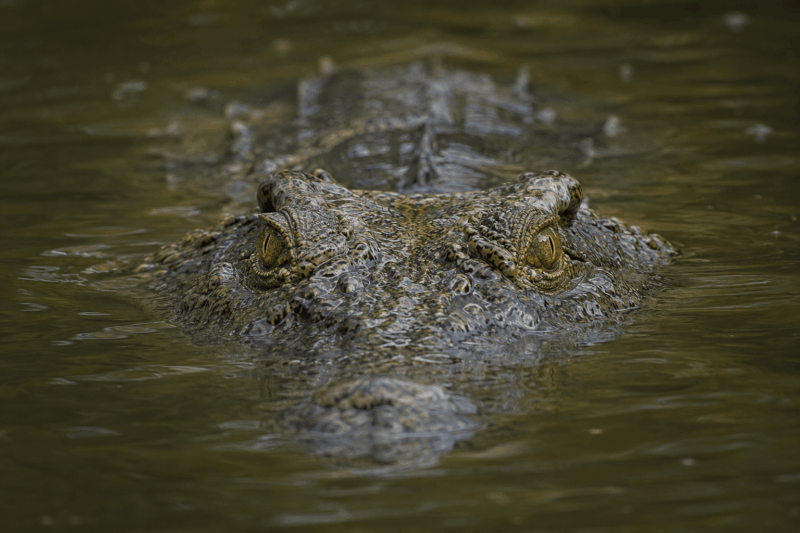
There’s a Nile crocodile loose somewhere in central Louisiana.
Not “loose” in the metaphorical sense — actually missing. Gone. Vanished from a horse trough after eating a bird, leaving behind only cinder blocks and questions. The crocodile, which can grow to 16 feet and 1,000 pounds, is somewhere out there in Ethel, Louisiana, doing crocodile things while the rest of us pretend this is fine.
The crocodile is not alone in its freedom. The same dysfunctional private zoo has also misplaced a Marabou stork, a lynx, two Indian crested porcupines (one found dead on Highway 955), a family of capybaras, a mob of kangaroos, a flock of flightless Rheas, a herd of water buffalo, and an entire safari exhibit of bison, zebras, and antelope.
And now — because this story needed one more surreal twist — the founder just donated the whole operation to his employees and walked away.
The Founder Who Wanted Out
Gabriel Ligon, 34, started with a macaw named Cisco, a cockatoo named Andrew, and a $10,000 student loan. He bought an acre of his grandfather’s farmland in Ethel, built a barn with an apartment, and scaled up aggressively. What began as a wildlife rehabilitation dream became Barn Hill Preserve, then Magnolia Wilds, then — after 43 USDA violations, a felony theft charge, and a giraffe confiscation lawsuit — a cautionary tale about what happens when ambition collides with reality and a missing crocodile.
Last week, Ligon donated the zoo’s roughly 125 remaining animals to a group of employees who are turning the facility into a nonprofit called Sanctuary Hill. He says he’s done with zoos forever and wants to return to jungle conservation.
“I can promise that I will never work and/or participate in the zoo industry again,” Ligon said.
A chorus of former staffers wish the zoo would go away too.
“It’s Close to ‘Tiger King'”
Josh Webb worked as a zookeeper from April to November 2025. His assessment: “It’s not as messy as ‘Tiger King’ was. But it’s close.”
The dysfunction was structural, not incidental. Payroll arrived late. Food deliveries ran out by the weekend. A red river hog gored an employee’s leg. A window fell out of the hyena enclosure — and one of the hyenas bit a teen. (He was fine.) Employees routinely took newborn kangaroos, wildcats, and goats home overnight for round-the-clock feeding. Former animal care specialist Avery Stewart remembers playing with a wildcat kitten on her bed — a kitten that “could rip out my jugular.”
The pool where visitors paid $215 to swim with otters and penguins was frequently bright green with algae. The otters bit guests. Instructors were told to downplay the bites as “just animal things” and offer Neosporin and a Band-Aid.
Ligon’s defense: “If you work in a high-rise office, your printer might break, while if you work at a zoo, an animal may escape.”
Fair point — except most offices don’t lose porcupines the night before a USDA inspection.
The Night Before the Inspection
In 2024, Ligon rebranded the zoo as Magnolia Wilds. The night before the inspection to get the new name approved, he told staff to move two Indian crested porcupines — Owen and Rebel — to a bigger enclosure. Staff warned him that porcupines are tunnelers and that the enclosure had no dig guards.
The next morning, both porcupines were gone.
Owen was found disoriented in the woods. Rebel was spotted dead on Highway 955.
Between 2021 and February 2025, USDA inspectors documented 43 infractions at the zoo — including the parasite-induced deaths of two alpacas, a flea infestation that killed a Sand Cat, and an insufficient barrier between the lynxes and the public. Ligon sued the USDA over the agency’s confiscation of a giraffe, claiming the bad press cost the zoo $1 million a year.
Then came the felony theft charge in January, stemming from a business dispute with another zoo owner. Some former employees hoped the arrest would force the animals to be sent to better-resourced facilities.
Instead, Ligon handed the keys to his staff.
The New Plan — and the Old Problems
Vet tech Lauren Cotton, 29, will take over as animal care director at Sanctuary Hill. She signed a nondisclosure agreement with Ligon and says keeping the animals in their current homes is the most ethical choice. The plan: end encounters with humans (except maybe feeding the sloths), pursue accreditation from the Global Federation of Animal Sanctuaries, and move forward.
GFAS executive director Valerie Taylor says she can’t remember any facility successfully transitioning from for-profit to sanctuary — and hand-feeding sloths would be a nonstarter for accreditation. But Taylor said they’d be glad to help.
Former employees are skeptical. They point to the lack of prior zookeeping experience among the new leadership and no clear plan to pay for the animals’ care. “It was one of those places where something is always going wrong,” said Haley Berger, a former tour guide.
On a recent visit, the property looked tidy. Godzilla the rescue Sulcata tortoise lounged in a shaded yard. Parrots and macaws that had outlived their owners squawked in a giant aviary. The enclosures were clean. The grass was mowed. The animals seemed content.
Ligon walked the property in ostrich boots and a duck-patterned shirt, defending his legacy. “We had a bee escape once,” he said. “I have to tell you, PR nightmare.”
The Stork That Wouldn’t Go Away
Around the same time Sanctuary Hill announced its inception, a large, bedraggled bird was spotted in Wisconsin. Zookeepers in an online group began asking whether any facility was missing a Marabou stork.
Former keeper Allison Balsamo, who moved home to Janesville, Wisconsin, after leaving Barn Hill, saw the post and recognized the description immediately.
“You can’t get away,” she said. “Even if you want to.”
The stork — like the crocodile, the lynx, the porcupines, and the water buffalo — is still out there somewhere. The zoo that lost them is now a nonprofit sanctuary run by well-intentioned employees and a mountain of inherited chaos.
Ligon is moving on to jungle conservation. The animals are staying put. The crocodile is still missing.
And somewhere in Louisiana, a horse trough sits empty.