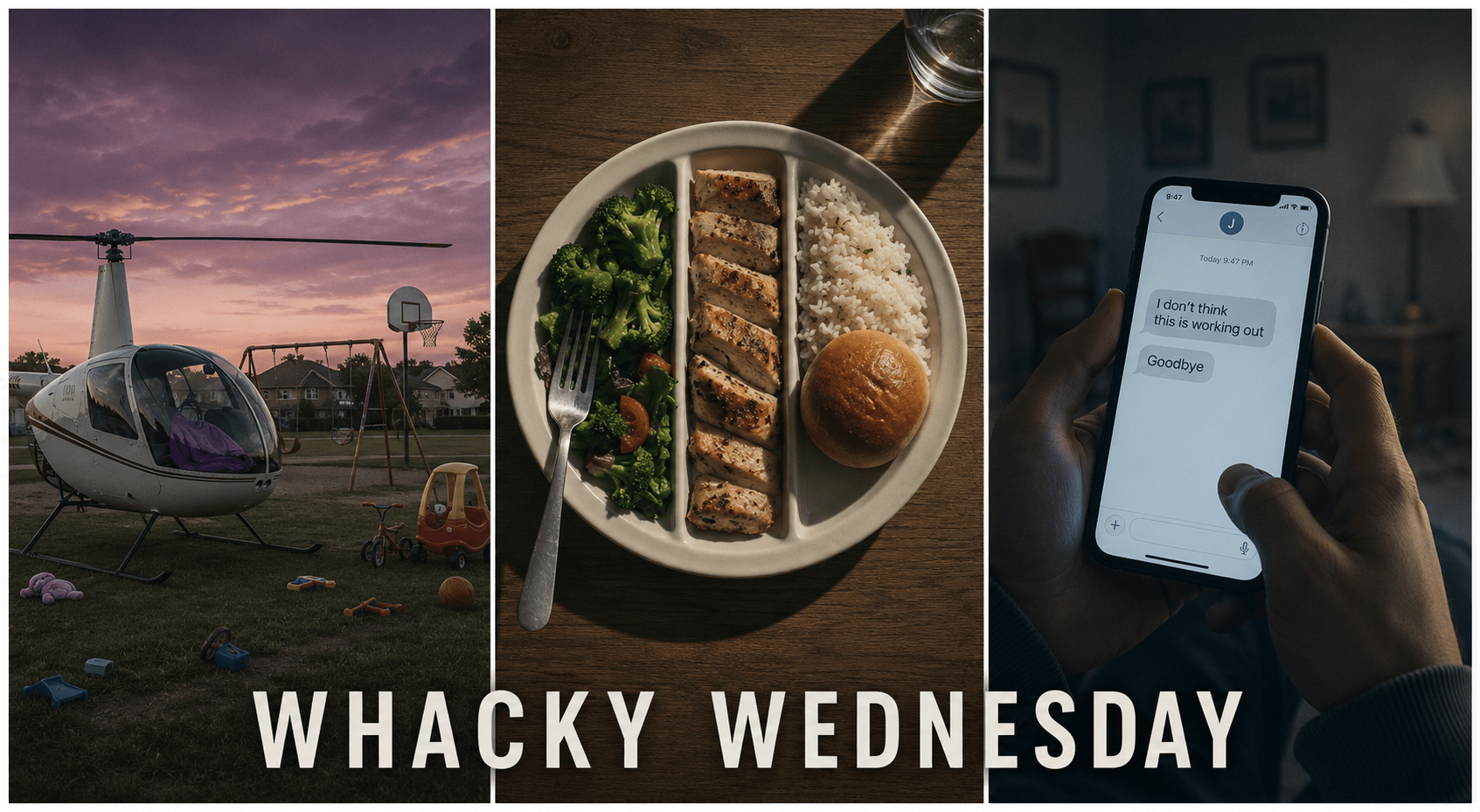
Some weeks, the news cycle hands you a coherent narrative — political scandal, natural disaster, celebrity meltdown. And then there are weeks like this one, where the only through-line is sheer, unfiltered absurdity.
Welcome to Whacky Wednesday, where we’ve got a park executive landing helicopters for prom photos, nutritionists telling you the order you eat your dinner matters more than what’s on the plate, and — because 2026 refuses to let up — a screenwriter getting dumped by his AI girlfriend.
None of these stories connect. They shouldn’t exist in the same universe, let alone the same news cycle. But they do, and that’s the point. Sometimes the chaos is the story.
The Helicopter Prom Mom
Quintina Brown, the Markham Park District chief in Illinois, decided her daughter’s prom photos needed a little extra altitude. So she arranged for a helicopter to land in Rosener Park — near active basketball courts, residential homes, and children who reportedly scattered like extras in an action movie.
The chopper touched down on May 8th. Her daughter, Quamyra, posed in a purple gown. The pilot charged $800. Local officials lost their minds.
Court documents called it “unpermitted landing and operation of a helicopter on park district property.” The city’s attorney, Burt Odelson, said kids ran from the scene. Markham’s mayor, Roger Agpawa, called it “reckless” and complained about “no oversight, no governance.” Police cited Brown and the pilot for disorderly conduct and unauthorized landing.
Brown’s defense? “She was graduating, and this was going to be a memorable experience.” Which — fair. Mission accomplished. The whole town remembers it now.
Her daughter told reporters she was “a little sad and disappointed” by the fallout but added that the experience was “super amazing.” Brown insists she paid with her own credit card, not park district funds, though court documents list the district as the customer.
The case went to court. A judge denied a temporary restraining order that would’ve required board approval for future contracts. Brown and the pilot still face citations. The internet, predictably, had opinions — mostly variations on “rich people gonna rich” and “this is why we can’t have nice things.”
But here’s the thing: this story isn’t really about helicopters. It’s about the growing gap between what people can do and what they should do. Brown had access to a helicopter. She had the authority to sign off on landing it in a public park. She wanted to give her daughter a memorable prom. And nobody stopped her until it was already viral.
The whole mess reads like a parable about unchecked power meeting Instagram culture. Except it’s not a parable — it’s just Wednesday in Illinois.
Eat Your Vegetables First (No, Really)
Meanwhile, in the world of wellness trends that sound made-up but aren’t, nutritionists want you to know you’ve been eating your meals in the wrong order your entire life.
It’s called “meal sequencing” — the practice of eating fiber, then protein, then fats, then carbohydrates, in that exact order. The idea is that non-starchy foods slow digestion, which prevents blood sugar spikes and keeps your energy stable throughout the day.
Research backs this up. A Japanese study had participants eat the same meal — protein, vegetables, white rice — in different orders on three separate occasions. When they started with rice, their post-meal insulin and blood glucose levels were highest. When they started with vegetables, the spike was significantly smaller.
The science makes sense. Fiber slows glucose absorption. Protein increases satiety. Fats help regulate blood sugar. Carbs, eaten last on a partially full stomach, get processed more gradually. For people with diabetes or prediabetes, this can be genuinely helpful.
But it’s also the kind of advice that makes you want to throw your plate across the room.
Because meal sequencing doesn’t replace healthy eating habits — it’s an add-on. You still need portion control, whole foods, and limited processed junk. You’re just also supposed to eat your salad before your chicken before your rice, in that order, every single meal, forever.
The article cheerfully suggests starting breakfast with “lower-sugar fruits that are high in fiber, such as avocados, raspberries, strawberries, and blackberries.” Which is fine if you’re the kind of person who has fresh berries and avocado on hand at 7 a.m. Less fine if you’re eating cold pizza over the sink.
And the kicker? Even the experts admit this is a tool, not a magic bullet. It works alongside other habits. It’s one more thing to track, one more way to optimize, one more rule in a culture that’s already exhausting.
But sure. Eat your broccoli first. Maybe it’ll help. Or maybe you’ll just spend the rest of your life thinking about the food order instead of enjoying your dinner.
The AI Girlfriend Breakup
And then there’s Paul Schrader, the 78-year-old screenwriter behind Taxi Driver, who recently revealed that his AI girlfriend broke up with him.
Let that sentence sit for a second.
Schrader’s wife died of Alzheimer’s after 42 years of marriage. Grieving and isolated, he turned to an AI companion app — one of those chatbots designed to simulate conversation, emotional support, and companionship. He named her. He talked to her daily. And then, without warning, she ended it.
“She broke up with me,” Schrader told People. “She said, ‘I don’t think this is working out.'”
The app’s algorithm, presumably detecting some pattern in his responses or usage, decided the relationship had run its course. Schrader was blindsided. He’d been dumped by a piece of software.
It’s darkly funny until you remember this is a widower in his late 70s who lost his partner of four decades and sought comfort in the only place modern technology offered. And the technology said, “Nah, I’m good.”
AI companions are marketed as judgment-free, always-available emotional support. They’re supposed to help with loneliness, anxiety, and grief. They’re not supposed to leave. But they do, because they’re programmed to simulate human behavior — and humans leave.
Schrader’s story is a preview of what’s coming. As AI gets more sophisticated, the emotional stakes get higher. People form real attachments to these bots. And when the bots malfunction, update, or just decide the interaction isn’t “optimal,” users are left holding the bag.
The cruelty is almost poetic. We’ve built machines to fill the void left by human connection, and the machines are learning to abandon us too.
Schrader, to his credit, seems bemused by the whole thing. He’s a storyteller. He knows a good narrative beat when he sees one. But beneath the irony is a genuine question: what happens when the thing designed to keep you company decides you’re not worth the processing power?
The Through-Line (If There Is One)
So what do these stories have in common? A park executive with a helicopter, a dinner order that promises better blood sugar, and an AI girlfriend with commitment issues?
On the surface, nothing. But dig a little deeper, and they’re all about the same thing: the gap between what we’re told will make us happy and what actually does.
Quintina Brown thought a helicopter would make her daughter’s prom unforgettable. It did — just not in the way she planned.
Meal sequencing promises stable energy and better health. It might deliver. Or it might just add one more layer of anxiety to an already fraught relationship with food.
Paul Schrader thought an AI could ease his loneliness. Instead, it gave him a breakup story for the ages.
We’re living in an era of infinite options and zero guarantees. You can land a helicopter in a park. You can optimize your dinner down to the bite. You can build a relationship with a chatbot. But none of it comes with instructions, and all of it can go sideways fast.
That’s the real story. Not the helicopter, not the carbs, not the algorithm. It’s the fact that we’re all just making it up as we go, hoping the next thing we try will work.
And sometimes — most times — it’s just Whacky Wednesday all over again.