Some weeks, the news feels like it was assembled by a committee that got locked in a room with a dartboard and a bottle of bourbon. This is one of those weeks.
Three stories landed in the feed over the past few days — a dog accidentally discharging a shotgun in Nebraska, a man vandalizing pickleball nets in Pennsylvania because his “summer was ruined,” and the Connecticut Department of Transportation misspelling “Ivoryton” as “Ivorytown” on three separate road signs. Individually, they’re absurd. Together, they form a triptych of institutional incompetence, emotional meltdowns, and the kind of chaos that only happens when humans (and one very unlucky dog) are involved.
The Dog With the Shotgun
Start in Scottsbluff, Nebraska — a town that now has to explain to the rest of the country why a dog shot someone at a convenience store.
The Scottsbluff Police Department responded to a call at Short Stop on Avenue I after receiving reports of a BB gun incident. En route, officers were informed it was actually a shotgun. A shotgun. In a truck. With a live shell in the chamber. And a dog.
The owner had pulled into the convenience store with a camper attached. While the passenger stood near the front door, the dog — doing what dogs do — moved from one side of the vehicle to the other. In the process, it triggered the shotgun. The blast tore through the passenger-side door panel and sent a single pellet across the parking lot, striking a woman stopped at a traffic light with her arm resting out the window.
She was transported to Regional West Medical Center by a family member. Her injury was not life-threatening, which is the only reason this story doesn’t end with a very different headline.
The Mechanics of a Canine Discharge
The police report doesn’t specify the breed, the dog’s name, or whether it had any prior firearms experience. It also doesn’t explain why a loaded shotgun was accessible to a dog in the back seat of a truck at a convenience store in broad daylight. Those details — the ones that might make this make sense — are conspicuously absent.
What remains is a perfect example of what happens when convenience, negligence, and a total lack of foresight converge in a parking lot on a Saturday afternoon.
The Pickleball Vandal
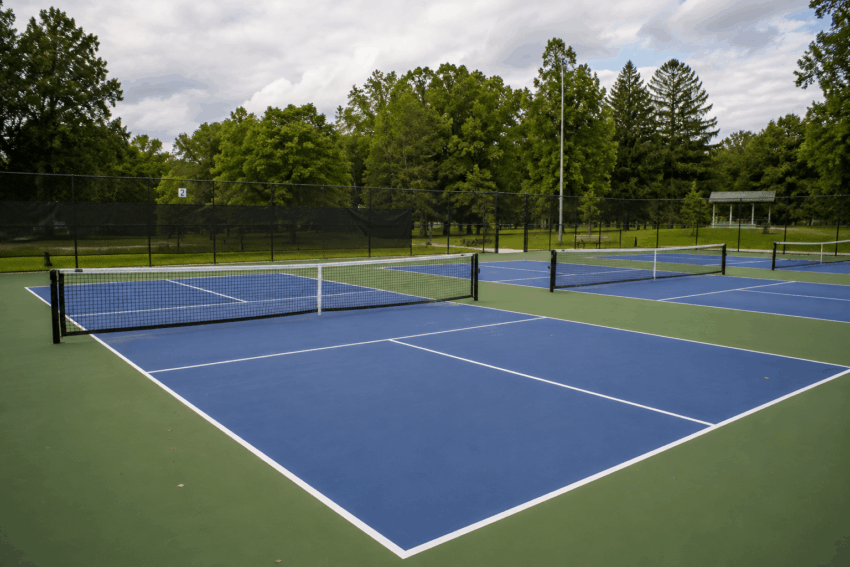
Meanwhile, in Monroe County, Pennsylvania, 31-year-old Saif Kaleem was arrested after allegedly cutting pickleball and tennis nets at two Pocono Township parks — TLC Park and Mountain View Park.
Surveillance footage from May 12 captured Kaleem cutting a pickleball net at TLC Park before leaving in a white Hyundai Tucson. Two days later, the same vehicle was recorded entering Mountain View Park around 9 p.m. — an hour after the park officially closed. Kaleem exited the vehicle, entered the pickleball courts, and proceeded to cut all three pickleball nets and one tennis net.
When officers later spoke with him at his residence, Kaleem admitted to the vandalism. His explanation? His “summer was ruined” following a recent pickleball injury at Mountain View Park.
The Injury That Launched a Crime Spree
The police report doesn’t detail the nature of the injury — whether it was a twisted ankle, a pulled muscle, or something more existentially devastating. But whatever it was, it was enough to justify a multi-day campaign of net destruction across two municipal parks.
Kaleem is now facing charges of criminal mischief and related offenses. The nets, which presumably had nothing to do with his injury, are being replaced. The summer, as far as anyone can tell, remains ruined.
The Sign That Couldn’t Spell
And then there’s Connecticut, where the Department of Transportation managed to misspell “Ivoryton” as “Ivorytown” on three separate road signs.
The signs went up over the winter — one on Route 153 in Westbrook, two others on Route 80 in Deep River. One of the Deep River signs was placed directly in front of the resident trooper’s office, raising questions about how long it takes someone in law enforcement to notice a typo.
Residents who drove by the signs didn’t catch the mistake right away. Anthony Cannella of Essex initially read the sign as directions. Karen Kilby of Centerbrook needed a second look before realizing the error. Michael Bonacorsa, a self-described “word guy” and lawyer, had a different take: “Just leave it.”
The DOT removed the Westbrook sign on Tuesday. The contractor responsible for the signs will replace them at no cost to the state, which is the bureaucratic equivalent of a participation trophy.
The older signs in the area — the ones installed before someone decided to wing it on the spelling — have the correct spelling. The new signs, once they’re installed, will presumably also have the correct spelling. In the meantime, Ivoryton remains a village in Essex, not a town, and the internet has another reason to mock Connecticut.
The Thread That Connects Them
Three stories. Three states. Three completely unrelated failures.
But they share a common DNA — the kind of low-stakes chaos that happens when systems break down, when attention lapses, when someone forgets to check the chamber or proofread the sign or take a breath before grabbing a pair of scissors and heading to the park.
The dog didn’t mean to shoot anyone. The contractor didn’t mean to misspell the sign. Kaleem, presumably, didn’t wake up one morning and decide his life’s purpose was to wage war on pickleball infrastructure. But intent doesn’t matter when the outcome is a woman with a pellet in her arm, a village with the wrong name on three road signs, and a man facing criminal charges because he couldn’t let go of a sports injury.
This is the texture of reality — not the big, dramatic failures that make headlines for weeks, but the small, absurd ones that pile up in the margins. The ones that make you wonder how anything gets done at all.
And the answer, as these three stories suggest, is that sometimes it doesn’t.