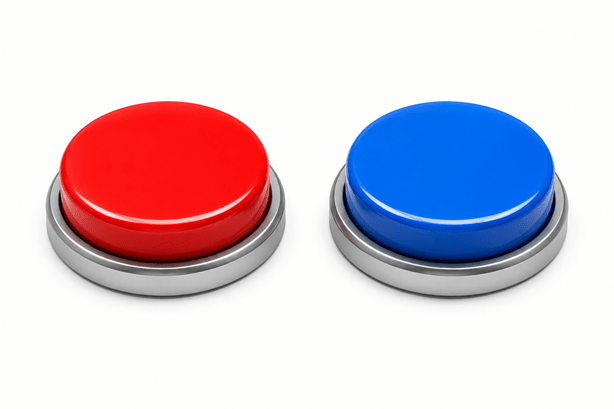
A thought experiment is tearing through social media like a brushfire through dry grass. The setup: everyone on Earth votes privately by pressing either a red or blue button. If more than 50% press the blue button, everyone survives. If fewer than 50% press blue, only the red-pressers live. Which do you choose?
The red button-blue button dilemma has spawned thousands of replies, each more convinced than the last that the answer is obviously theirs. Red-pressers call blue-pressers suicidal idealists. Blue-pressers call red-pressers sociopaths. Both sides are certain they’ve cracked the code.
Steven Conway, a game theory expert from Swinburne University of Technology, has a different take — the question isn’t really about buttons at all.
The Case for Red: Self-Interest as Strategy
The logic for red is airtight, at least on paper. If more than half the planet presses blue, you survive either way. If fewer than half press blue, only red-pressers make it. Basic self-preservation points to red every time.
In game theory terms, this is the Nash equilibrium — the choice that maximizes your own survival regardless of what everyone else does. You’re not gambling on humanity’s better angels. You’re hedging your bets.
One commenter tried to simplify it with a meme dubbing blue the “Ultimate Death Gamble.” Fair enough.
The Case for Blue: Collective Survival (or Guilt Management)
And yet — in multiple polls, blue wins. MrBeast’s version pulled 56% for blue. Which raises the question: why would anyone stake their life on the collective judgment of eight billion strangers?
Conway suggests a few possibilities. Maybe you’re worried your family will press blue and you want them to survive. Maybe you’d feel responsible for billions of deaths if you pressed red. Maybe you believe — against all available evidence — that humanity is fundamentally good.
Or maybe you just don’t want to be the guy who pressed the red button.
In game theory, this is the Pareto-optimal outcome — the choice that minimizes total harm. You’re not optimizing for yourself. You’re optimizing for the species.
Why This Question Went Viral in 2026
The red button-blue button dilemma isn’t new. Variations have existed for decades. But it’s catching fire now for a reason.
We’re living in an era of cascading interdependence. A supply chain hiccup in one country triggers shortages everywhere. A financial crisis in one market crashes portfolios on three continents. A virus in one city becomes a global pandemic. We’ve never been more connected — or more aware of how fragile that connection is.
Conway points to what philosopher Günther Anders called the “Promethean gap” — the widening chasm between our technological capacity and our moral imagination. We can end the world at the push of a button, but we can’t quite wrap our heads around what that means.
Shows like Squid Game, Survivor, and The Hunger Games all traffic in the same anxiety: who can you trust when the system rewards betrayal? What happens when survival becomes a zero-sum game?
The red button blue button dilemma is a moral apocalypse condensed into a tweet — perfect for an audience that’s exhausted, overstimulated, and perpetually three headlines away from despair.
The Algorithm Loves a Binary
Social media thrives on false binaries. Gold dress or blue dress. Laurel or Yanny. Red button or blue button. Nuance doesn’t drive engagement. Certainty does.
The question is designed to provoke — not just because the stakes are existential, but because it forces you to declare allegiance. Are you selfish or selfless? Rational or naive? A realist or an idealist?
The answer, predictably, is more complicated than either button allows. But complexity doesn’t go viral.
What Your Answer Actually Reveals
Conway’s analysis suggests that your choice reveals less about your morality than about your assumptions. Red-pressers assume others will act in self-interest, so they do the same. Blue-pressers assume — or hope — that enough people will cooperate to make cooperation rational.
Both are making predictions about human behavior under pressure. Neither can be proven right until the button is pressed.
Which means the real question isn’t “What would you do?” It’s “What do you think everyone else would do?” And that — the gap between your choice and your faith in others — might be the most revealing answer of all.
Source: The Conversation