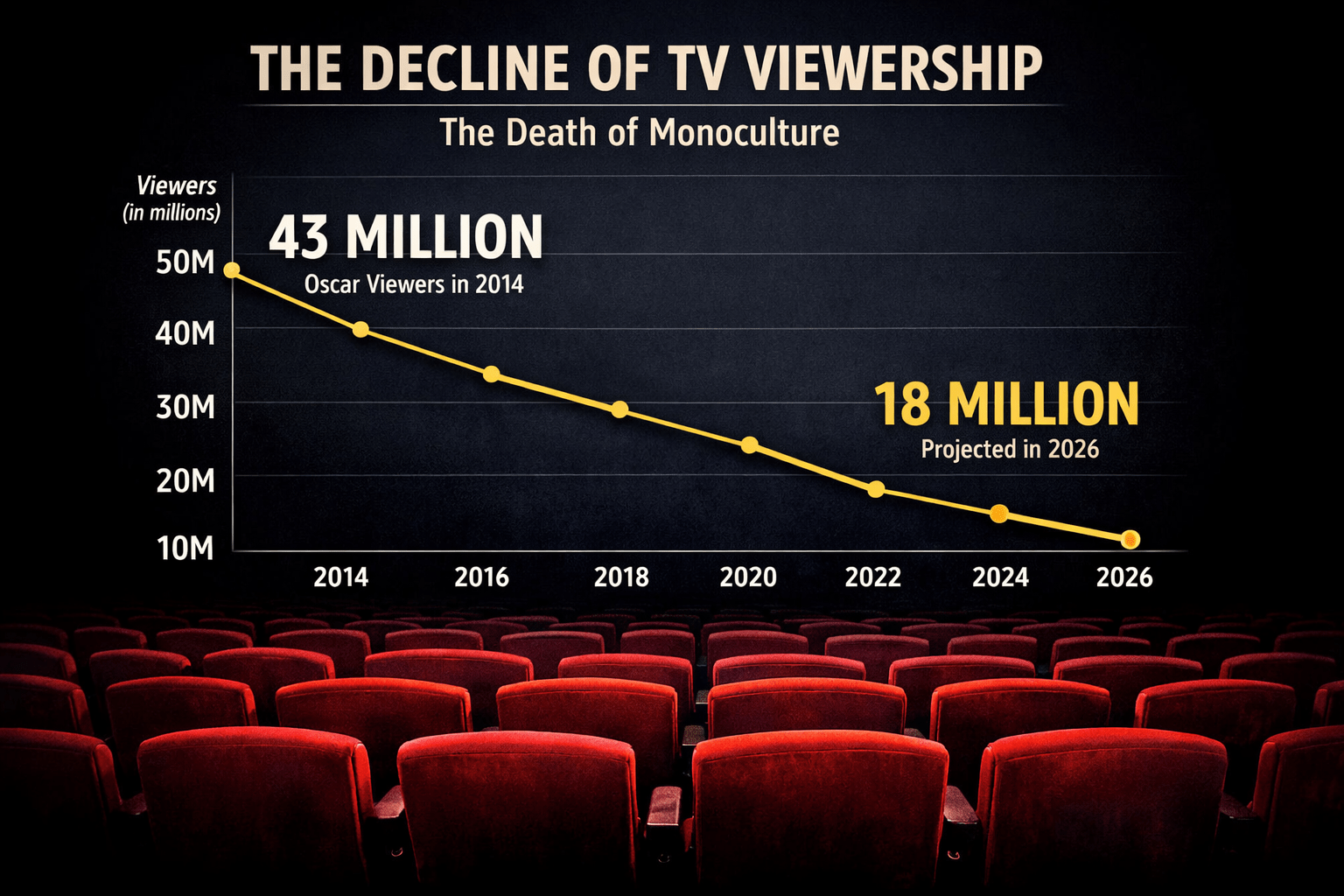
Bradley Cooper took a selfie at the 2014 Oscars. Ellen DeGeneres posted it. The internet exploded. 43.74 million people watched it happen live — the Academy Awards’ largest audience in 14 years.
No one knew it at the time, but monoculture died in 2014 — or at least peaked that night before beginning its long, inevitable decay.
The photo itself became a multi-day news cycle. Samsung (the phone’s manufacturer and a major sponsor) got free publicity worth millions. Twitter declared it the most retweeted post in the platform’s history. For a brief moment, everyone — your mom, your boss, that guy at the gym — was talking about the same thing.
That doesn’t happen anymore.
The Numbers Tell the Whole Story
In 2014, broadcast and cable TV were still the dominant forces. More than 100 million U.S. households subscribed to multi-channel providers. The Grammys pulled 28.5 million viewers. The Golden Globes brought in nearly 21 million. Even the Emmys — which have always been the awards show equivalent of eating vegetables — drew 15.59 million.
Regular series thrived, too. Twenty-four network and cable shows averaged 12 million or more viewers. The Big Bang Theory and NCIS each topped 22 million. The Walking Dead and Downton Abbey were water-cooler staples.
Today? The Oscars draw around 18 million. The Grammys managed 14.41 million in 2026. Only three broadcast shows (Marshals, Tracker, High Potential) crack the 12-million-viewer mark.
The decline isn’t subtle — it’s a cliff.
Streaming Killed the Broadcast Star
In 2014, Netflix was still considered the “Albanian army” by Time Warner CEO Jeff Bewkes — a dismissive jab that aged like milk in the sun. The company had just launched House of Cards the year before. Streaming was a curiosity, not a threat.
At the time of the Oscars selfie, exactly 14 original streaming shows existed across Netflix, Hulu, and Amazon Prime Video.
By 2019, that number had exploded to 532 English-language scripted series.
Disney+ and Apple TV+ launched that year. HBO Max and Peacock followed in 2020. The streaming arms race was on — and the casualty was any hope of a shared cultural language.
The Algorithm Ate the Monoculture
The pandemic accelerated the fracture. With productions shut down, people turned to YouTube, TikTok, and algorithm-driven feeds that served up personalized content — which, by design, meant no two people were watching the same thing.
Scrolling replaced daytime soaps and talk shows. The “play next” ticker became the new programming director. Passive consumption — letting the algorithm decide what you watch — became the default mode.
And here’s the thing: it works. Personalized content keeps people glued to their screens. But it also means the idea of a shared pop culture moment — the kind where you could reference a TV show or a song and assume most people knew what you were talking about — became quaint. Nostalgic. Dead.
What We Lost (and What We Didn’t)
Monoculture wasn’t entirely benevolent. Gatekeeping. Dumbing down. A handful of executives deciding what everyone should watch. Those are legitimate criticisms.
But in a fragmented world — politically, socially, algorithmically — where tech tools let people question reality itself, the idea of a widely shared pop cultural language feels almost romantic.
There are still big moments. Super Bowls. The Eras Tour. The end of Stranger Things. Project Hail Mary’s unexpected box office run.
But they’re exceptions now, not the rule.
The Selfie Was the Peak
Looking back, the 2014 Oscars selfie feels like the last stand of a shared popular culture that no longer exists. It was a moment when everyone — regardless of age, geography, or taste — was paying attention to the same thing at the same time.
The numbers have been in decline ever since. Not gradually — precipitously. From 43 million to 18 million. From 24 shows averaging 12 million viewers to three. From a handful of streaming originals to hundreds.
The monoculture didn’t die with Bradley Cooper’s selfie. But that night may have been its last peak.
And no one knew it at the time.
Source: Hollywood Reporter