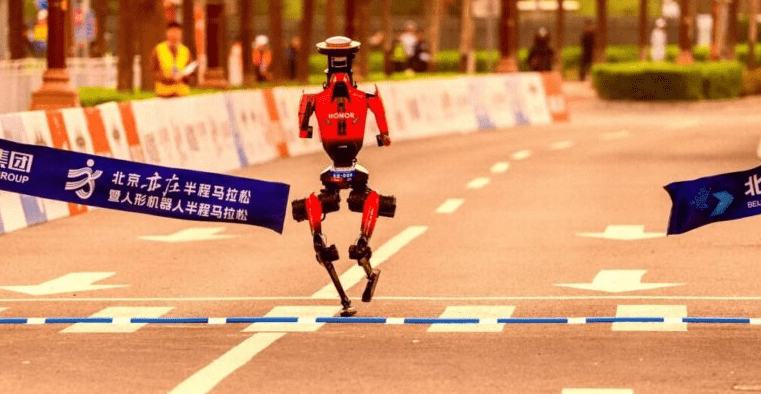
A Chinese humanoid robot just completed a half-marathon in less time than the fastest human ever recorded.
Not “pretty close.”
Not “almost as fast.”
Faster.
The robot — built by a Chinese robotics company — finished the 13.1-mile course in under an hour. The current human world record for a half-marathon is 57 minutes and 31 seconds, set by Ugandan runner Jacob Kiplimo in 2021. The robot beat it.
This wasn’t a controlled lab test. This was a public event with actual terrain, actual distance, and actual conditions. The robot ran the course autonomously — no remote control, no human intervention, no stopping to recalibrate. It just… ran.
And now we’re all supposed to act like this is just another tech milestone.
The Part Nobody Wants to Say Out Loud
Here’s what makes this different from every other “robot does impressive thing” story: this one crossed a threshold we’ve been pretending didn’t exist.
For decades, we’ve told ourselves that certain human capabilities — physical endurance, athletic performance, the biomechanical efficiency of the human body — were safe from automation. Sure, robots could weld car frames and assemble circuit boards, but they couldn’t run. Not like us. Not with the balance, the adaptability, the sheer biological elegance of a trained human athlete.
That story just ended.
The Chinese humanoid robot didn’t just complete a half-marathon. It beat the best human performance in recorded history. The gap between what our bodies can do and what engineered systems can do just became undeniable. And it happened faster than most people expected.
Boston Dynamics spent years getting its robots to walk without falling over. Now we’ve got a humanoid machine running 13.1 miles faster than Jacob Kiplimo — and doing it without breaking a sweat, because it doesn’t sweat.
What This Actually Means (Beyond the Obvious)
The immediate reaction is to focus on athletics — “Will robots compete in marathons?” or “What does this mean for the Olympics?” — but that’s missing the point.
This isn’t about sports.
This is about the last remaining category of tasks we assumed required human bodies. Physical labor. Endurance work. Jobs that demand sustained movement over long distances or extended periods. Delivery workers. Warehouse staff. Security patrols. Construction site navigation.
If a humanoid robot can run a half-marathon faster than the fastest human, it can walk a 12-hour shift without fatigue. It can carry loads without muscle strain. It can navigate uneven terrain without increasing the risk of injury. It can work in environments where heat, cold, or air quality would incapacitate a person.
And it can do all of that without health insurance, bathroom breaks, or workers’ compensation claims.
The economic implications aren’t subtle.
The Uncomfortable Part About Chinese Innovation
The fact that this breakthrough came from China — not Boston, not Silicon Valley, not a well-funded American robotics lab — is the detail that will make a lot of people uncomfortable.
For years, the narrative in Western tech circles has been that China excels at manufacturing and scaling, but the innovation still happens here. The cutting-edge stuff. The breakthroughs. The “we invented it, they copied it” storyline.
This doesn’t fit that narrative.
A Chinese company just built a humanoid robot that outperformed the best human athlete in history at a task requiring balance, endurance, and real-time environmental adaptation. That’s not incremental improvement. That’s not copying. That’s a capability leap — and it happened outside the ecosystem we’ve been conditioned to think of as the only one that matters.
The geopolitical implications of that will reverberate for years.
The Question Nobody’s Asking Yet
Here’s the thing that’s been sitting in the back of my mind since I saw this story: if a humanoid robot can run a half-marathon faster than any human, what’s the upper limit?
Because humans have biological constraints. We overheat. Our muscles fatigue. Our joints wear down. Our cardiovascular systems can only deliver oxygen so efficiently. Evolution optimized us for survival, not for breaking speed records.
Robots don’t have those constraints.
So what happens when the engineering gets better? When will the power systems get lighter? When do the control algorithms get more efficient? What happens when this isn’t a breakthrough — it’s just the baseline?
The gap between human capability and machine capability isn’t going to narrow. It’s going to widen. And we’re going to have to figure out what that means for jobs, industries, and the identities built on the assumption that human bodies were irreplaceable.
The Part Where I Don’t Have an Answer
I don’t know what comes next.
I don’t know whether this leads to a world where humanoid robots replace physical laborers en masse, or to a new category of human-robot collaboration we haven’t imagined yet. I don’t know whether this accelerates the push for universal basic income or just accelerates inequality. I don’t know if this makes life better or just more efficient.
What I do know is that the line between “impressive technology” and “existential disruption” just got a lot thinner.
A Chinese humanoid robot ran a half-marathon faster than the fastest human ever. That’s not a headline. That’s a threshold. And we just crossed it.
Photo Courtesy: Dnyuz.com