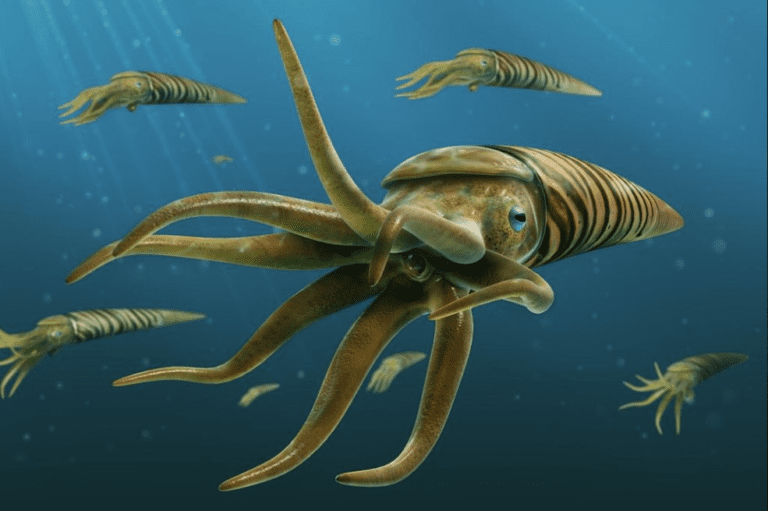
A 300-million-year-old blob of fossilized tentacles just lost its title as the world’s oldest octopus.
Turns out it was never an octopus.
It was a nautilus—a shelled cephalopod that decomposed so thoroughly before fossilization that it fooled paleontologists for 24 years.
The fossil, Pohlsepia mazonensis, was discovered in the Mazon Creek area of Illinois and officially declared the earliest known octopus in 2000. That designation upended evolutionary timelines, suggesting octopuses emerged 210 million years earlier than previously thought. The next oldest octopus fossil? A mere 90 million years old—a geological blink compared to this supposed ancient ancestor.
Except that the “ancient ancestor” was misidentified.
When “White Mush” Becomes a Scientific Controversy
University of Reading zoologist Thomas Clements led the team that finally solved the mystery. His assessment of the fossil: “To look at it, it kind of just looks like a white mush.”
Not exactly the stuff of museum placards.
But if you squint—and you’re deeply invested in cephalopod taxonomy—it does resemble a deep-water octopus. Which is how the misidentification happened in the first place.
The creature, roughly the size of a human hand, lived before dinosaurs walked the Earth. Its remains were trapped in Illinois bedrock during a period when the region was a shallow tropical sea. Over millions of years, it fossilized—minus the shell that would have made identification straightforward.
Clements and his team used a synchrotron—a particle accelerator that generates light brighter than the sun—to peer inside the fossil rock. They found a radula, a ribbon of teeth common to all mollusks. Each row had 11 teeth.
Octopuses have either seven or nine.
“This has too many teeth, so it can’t be an octopus,” Clements said. “And that’s how we realize that the world’s oldest octopus is actually a fossil nautilus, not an octopus.”
The teeth matched those of Paleocadmus pohli, a nautiloid previously found in the same area. The creature had simply decomposed so completely before fossilization that its shell—the defining feature of a nautilus—was gone.
Guinness World Records Quietly Updates the Leaderboard
Guinness World Records has officially retired the “oldest octopus fossil” title for Pohlsepia mazonensis. Managing Editor Adam Millward called the discovery “fascinating” and said the organization would review the new evidence.
The Field Museum in Chicago, which houses the fossil, took the news in stride. Paul Mayer, manager of the museum’s fossil invertebrate collection, admitted he was “a little surprised” but noted that scientists had questioned the octopus classification since the original 2000 paper.
Clements tried to soften the blow: “The Field Museum has a small collection of these ancient nautiluses, which I think, as a cephalopod worker, is probably the best thing ever.”
Translation: You don’t have the world’s oldest octopus, but you do have the oldest soft-tissue nautilus fossil. Consolation prize.
The 210-Million-Year Gap That Never Was
The misidentification had real consequences. It created a massive evolutionary gap—210 million years—between the supposed earliest octopus and the next oldest fossil. That kind of gap makes scientists nervous. It suggests either a wildly incomplete fossil record or a fundamental misunderstanding of cephalopod evolution.
Turns out it was neither. It was just a decomposed nautilus.
The findings were published this week in Proceedings of the Royal Society B. The paper concludes that Pohlsepia mazonensis is a nautiloid, not an octopod, based on dental morphology and anatomical features that are inconsistent with octopus evolution.
In other words: wrong teeth, wrong body, wrong classification.
What This Means for Fossil Misidentification Science
This isn’t the first time a high-profile fossil has been reclassified. Paleontology is littered with cases of mistaken identity—creatures initially thought to be one thing that turned out to be something else entirely. Decomposition, incomplete fossilization, and the sheer difficulty of interpreting ancient remains make misidentification almost inevitable.
What’s notable here is the technology. Synchrotron analysis—using particle accelerators to generate intense beams of light—allowed researchers to see inside the fossil without destroying it. That kind of non-invasive imaging is revealing new details about old specimens, forcing scientists to revisit assumptions made decades ago.
Mayer, from the Field Museum, said new technologies have brought renewed interest in the Mazon Creek fossils. “Hopefully, new discoveries will be made, and new stories will be revealed,” he said.
Translation: More fossils are about to get reclassified.
The Lesson: Even Fossils Can Have Identity Crises
The story of Pohlsepia mazonensis is a reminder that science is a process, not a destination. A fossil identified in 2000 can be reclassified in 2025 because improved tools and better questions yield more accurate answers.
It’s also a reminder that decomposition is a hell of a disguise. Lose your shell, wait 300 million years, and you can fool an entire field of researchers into thinking you’re something you’re not.
The Field Museum still has the fossil. It’s still significant. It’s just not an octopus anymore.
Which, depending on your feelings about cephalopods, may or may not be a downgrade.
Image Courtesy: Ferro Designs