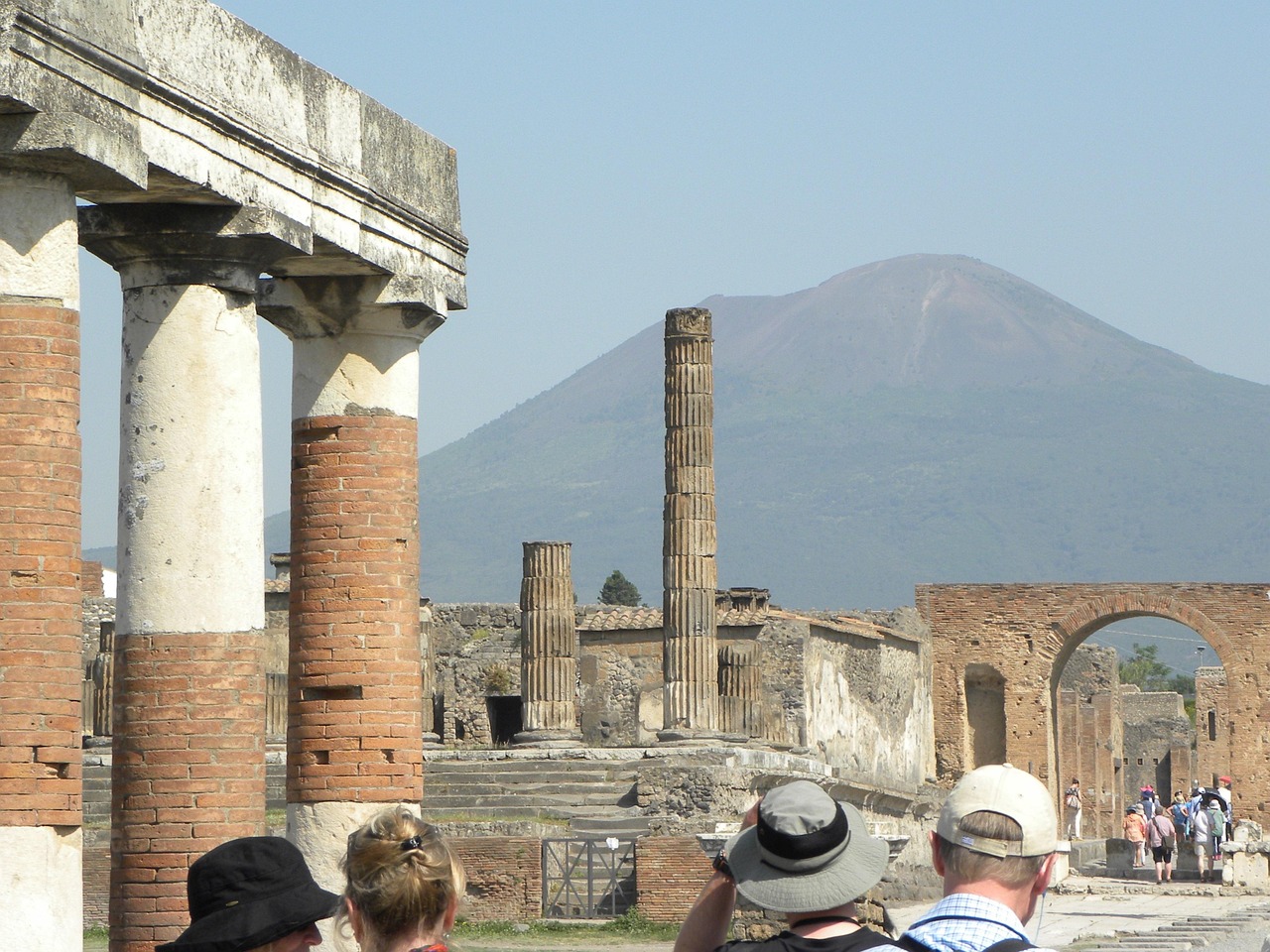
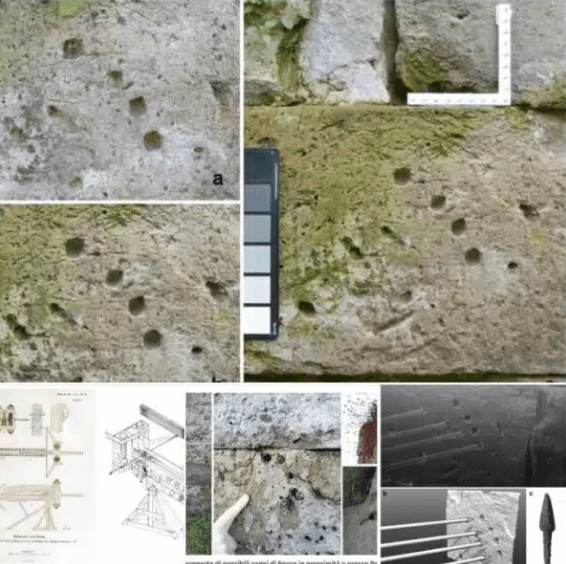
Tight clusters of quadrangular holes. Arranged in curved lines. Spaced at regular intervals along the northern stretch of Pompeii’s fortress walls.
Not random damage. Not erosion. Not the work of Mount Vesuvius, which buried the city under ash in 79 CE—nearly two centuries after these marks were made.
According to researchers led by Adriana Rossi of the University of Campania, these are impact signatures from a polybolos—a Greek-engineered, chain-driven dart launcher capable of firing projectiles in rapid succession. The ancient world’s closest analog to a belt-fed machine gun.
The marks date to 89 BCE, when Roman general Lucius Cornelius Sulla laid siege to Pompeii. His forces brought cutting-edge military technology to bear on a fortified city—and the walls remember.
A Weapon That Exists Only in Text—Until Now
Here’s the problem with the polybolos: no physical example has ever been found.
Everything we know about it comes from Philo of Byzantium, a Greek writer from the third century BCE who described the weapon in technical detail. Torsion-powered. Chain-drive mechanism. Automatic loading system. Capable of launching bolts in repeating bursts without manual reloading between shots.
Dionysius of Alexandria—a Greek engineer working in the arsenal of Rhodes—is credited with inventing it. But for over two millennia, the polybolos remained a ghost weapon. Described, never discovered.
Until Rossi’s team started scanning Pompeii’s walls with close-range photogrammetry, structured-light 3D scanning, and laser imaging. The high-resolution models revealed damage patterns that match the profile of military darts from the period—and nothing else in the known Roman arsenal fits.
The shape of the cavities. The spacing. The radial clustering near the gates of Vesuvius and Herculaneum. All consistent with a rapid-fire weapon delivering concentrated volleys at short intervals.
Mount Vesuvius Preserved the Evidence
Pompeii’s destruction became its time capsule.
When Vesuvius erupted in 79 CE, it buried the city under meters of ash and pumice—freezing everything in place. Including battle scars from a siege that happened 168 years earlier.
The eruption didn’t just preserve buildings and bodies. It preserved the forensic record of how ancient armies fought, what weapons they deployed, and how effective those weapons were against fortified stone walls.
Rossi’s team is now cross-referencing the physical damage patterns with Philo’s written descriptions to build a virtual 3D model of the polybolos. If they succeed, it would be the first reconstruction of the weapon based on actual field evidence—not just ancient engineering notes.
“Assembling the components of the polybolos in accordance with Philo’s treatise will enable a more in-depth exploration of its technical specifications,” the researchers noted in their paper, published in the journal Heritage.
Translation: we might finally understand how this thing actually worked in combat.
The Ancient World’s Rapid-Fire Problem
The polybolos wasn’t just a curiosity. It was a force multiplier.
Standard torsion catapults required manual reloading after each shot. Skilled crews could maintain a steady rate of fire, but there was always a gap—time for defenders to regroup, reposition, or return fire.
The polybolos eliminated that gap. Its chain-drive system fed bolts into the firing groove automatically, allowing continuous volleys without pause. Think of it as the difference between a bolt-action rifle and a machine gun.
For a besieging army, that meant sustained suppression fire. Defenders couldn’t stay on the walls. Couldn’t man the gates. Couldn’t organize a counterattack without taking concentrated fire from a weapon that didn’t stop shooting.
Sulla’s forces used it to devastating effect at Pompeii. The city fell. The walls still carry the proof.
What Does This Change About Roman Military History
If the polybolos was deployed at Pompeii, it wasn’t a one-off experiment. It was field-tested technology—reliable enough to bring to a siege, effective enough to leave permanent marks on stone fortifications.
That suggests the weapon was more widespread than historians previously believed. Not a theoretical design that never left the drawing board, but an operational tool in the Roman military arsenal.
It also means Greek engineering had a longer reach than we thought. The polybolos was a Hellenistic invention, developed in Rhodes centuries before Rome became a superpower. But Roman legions adopted, deployed, and used it to conquer cities across the Mediterranean.
The walls of Pompeii hold a rare, tangible record of that technology transfer—a snapshot of ancient warfare at its most sophisticated.
Source: Yahoo Canada