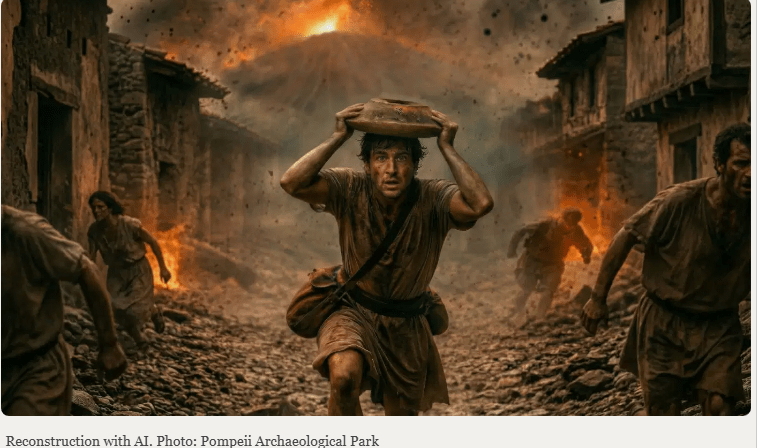
The Pompeii Archaeological Park just rolled out its first Pompeii AI reconstruction — a digital rendering of a man who died during the eruption of Vesuvius in 79 AD, clutching a terracotta mortar over his head like a makeshift helmet. The project, developed with the University of Padua’s Digital Cultural Heritage Lab, combines excavation data, photo editing, and machine learning to show what this guy might’ve looked like in his final moments.
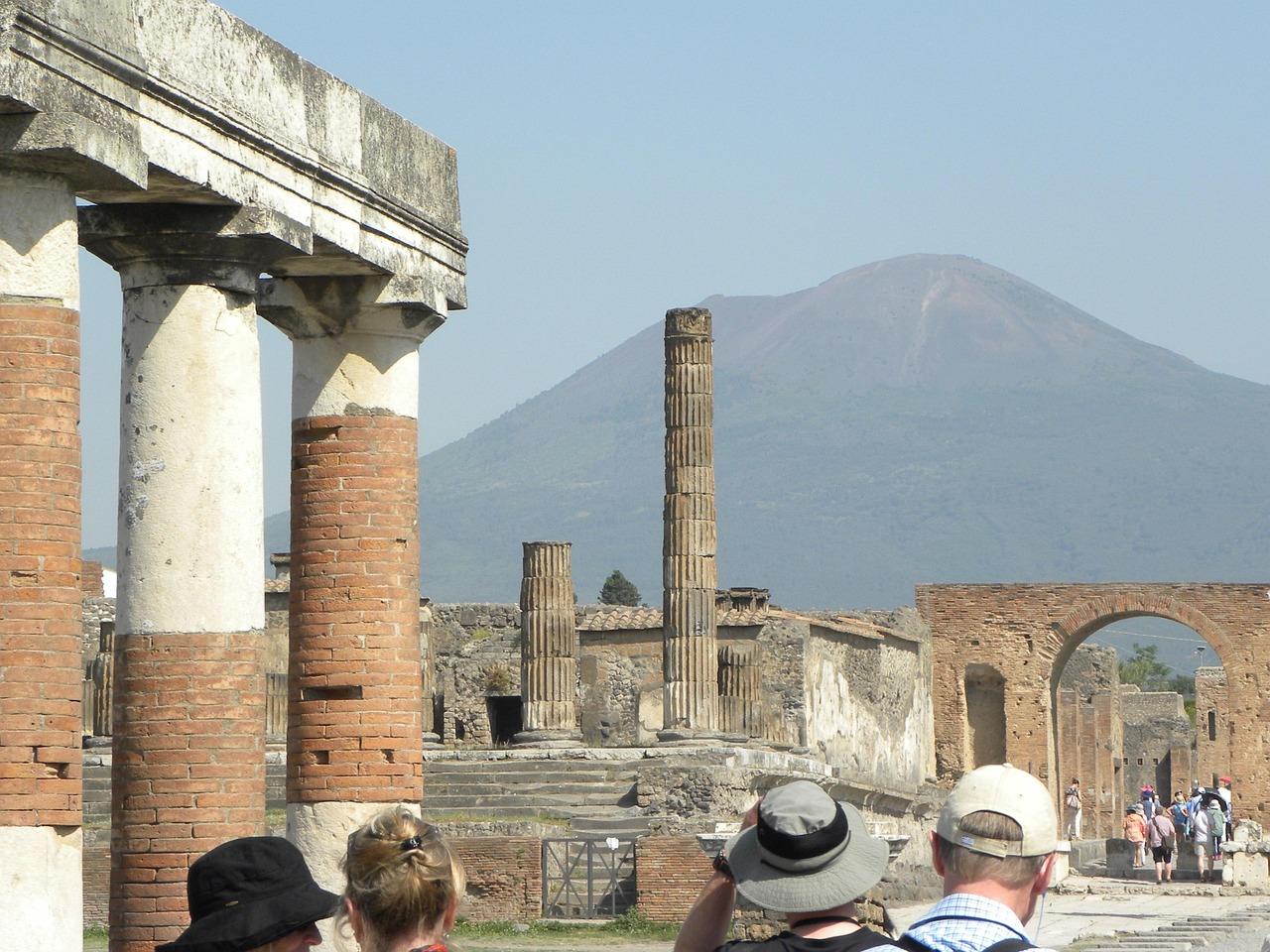
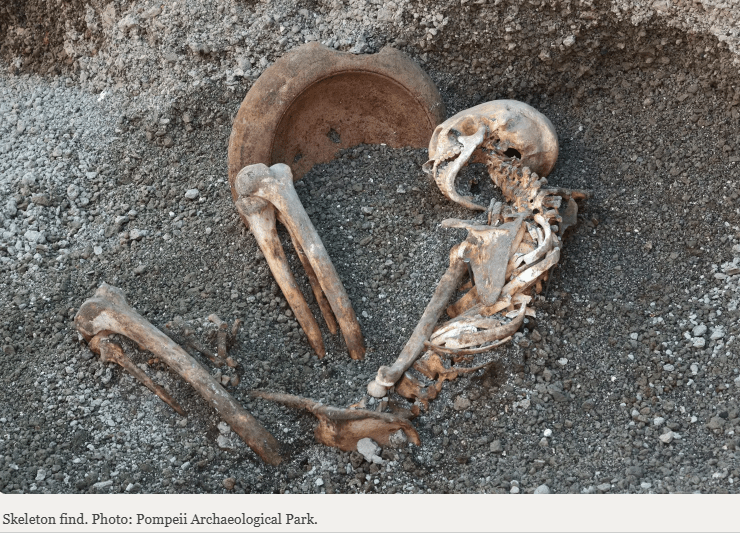
The remains were found outside the city walls at the Porta Stabia necropolis — part of ongoing digs around the tomb of Numerius Agrestinus Equitius Pulcher, a name that sounds like a law firm but was actually just one wealthy Roman’s eternal real estate. Two men were discovered trying to flee toward the coast. Both failed. One was younger, probably killed by a pyroclastic current — a fast-moving cloud of superheated gas and ash that doesn’t negotiate. The other, older, died earlier during a violent lapilli storm, volcanic rock fragments raining down like hail made of lava.
The older man — the one they reconstructed — had a few things with him: the mortar (visibly damaged, so it didn’t work), a ceramic oil lamp for navigating the smoke and darkness, a small iron ring on his left pinky, and ten bronze coins. Not enough to buy his way out, but enough to suggest he thought he’d need them later.
The Mortar-as-Helmet Move
The terracotta mortar detail tracks an account by Pliny the Younger, who described fleeing Pompeians tying pillows and other objects to their heads to shield themselves from falling debris. Practical, desperate, and — based on the outcome — not particularly effective. The mortar this man carried shows visible damage, meaning it took at least one hit before he did.
The lamp suggests he was moving in low visibility. The coins suggest optimism, or at least the Roman instinct to never leave home without cash. The ring on his pinky suggests… well, personal style survives even during an apocalypse.
How the Reconstruction Actually Works
The Pompeii AI reconstruction isn’t a magic trick — it’s a combination of photogrammetry, skeletal analysis, and generative software trained on historical and anatomical datasets. Archaeologists from the Ministry of Culture provided the hard data: bone structure, positioning, and objects in their original place. The University of Padua’s lab fed that into AI tools designed to interpolate soft tissue, musculature, and probable appearance based on demographic and genetic markers from the region.
The result is speculative but grounded — not a photograph, but not a cartoon either. It’s meant to make the research legible to people who don’t spend their days measuring femurs.
Gabriel Zuchtriegel, director of the Pompeii Archaeological Park, framed it this way: “The vastness of archaeological data in Pompeii and beyond is now such that only with the help of artificial intelligence will we be able to properly protect and enhance it.” Translation: there’s too much stuff buried under too much volcanic rock for humans alone to process in any reasonable timeframe.
The Ethics of Rendering the Dead
Luciano Floridi, founding director of Yale’s Digital Ethics Center, weighed in with a line that belongs on a museum wall: “The man of Pompeii fled with a mortar on his head, an oil lamp in his hand, and ten coins: he carried what seemed useful to him to orient himself in the dark. Two thousand years later, AI helps us reconstruct his final moments.”
He also issued the mandatory disclaimer: AI produces hypotheses, not truth. The reconstruction is a model, not a resurrection. The risk isn’t that the software gets it wrong — it’s that people stop distinguishing between interpretation and fact.
Jacopo Bonetto, a professor at the University of Padua, echoed the caution: the technology is useful for interpretive models and public communication, but it requires “controlled and methodologically grounded use, always in integration with the work of specialists.” In other words, don’t let the algorithm run unsupervised.
What This Means for Archaeology (and Everyone Else)
The Pompeii AI reconstruction is an experimental prototype, not a finished product. It’s designed to make classical studies more immersive — to give people a way into the past that doesn’t require a PhD in stratigraphy. Whether that’s a good thing depends on how tightly the guardrails hold.
Minister of Culture Alessandro Giuli called Pompeii “perhaps the most prestigious place in the world for archaeological research,” which is both true and the kind of thing you say when you’re trying to justify a budget line. But the broader point stands: Pompeii is a laboratory, and this is one more experiment in how we understand — and represent — the people who didn’t make it out.
The park is hosting Orbits – Dialogues with Intelligence in July, a conference focused on AI ethics and post-digital society. The timing is convenient. The questions are overdue.
The Man With the Mortar
Two millennia ago, a man grabbed a cooking pot, a lamp, some pocket change, and ran. He didn’t make it. Now his face — or a plausible version of it — exists in a dataset somewhere, rendered by software that didn’t exist five years ago.
The magic, as Floridi put it, is still human. The reconstruction accelerates the yield, but the interpretation, the context, the decision to show this man’s face to the world — that’s still on the archaeologists.
The mortar didn’t save him. The lamp didn’t guide him out. The coins were worthless in the end. But the data survived, and now the software can show us what he might’ve looked like when he realized none of it mattered.
Source: Finestre sull’Arte