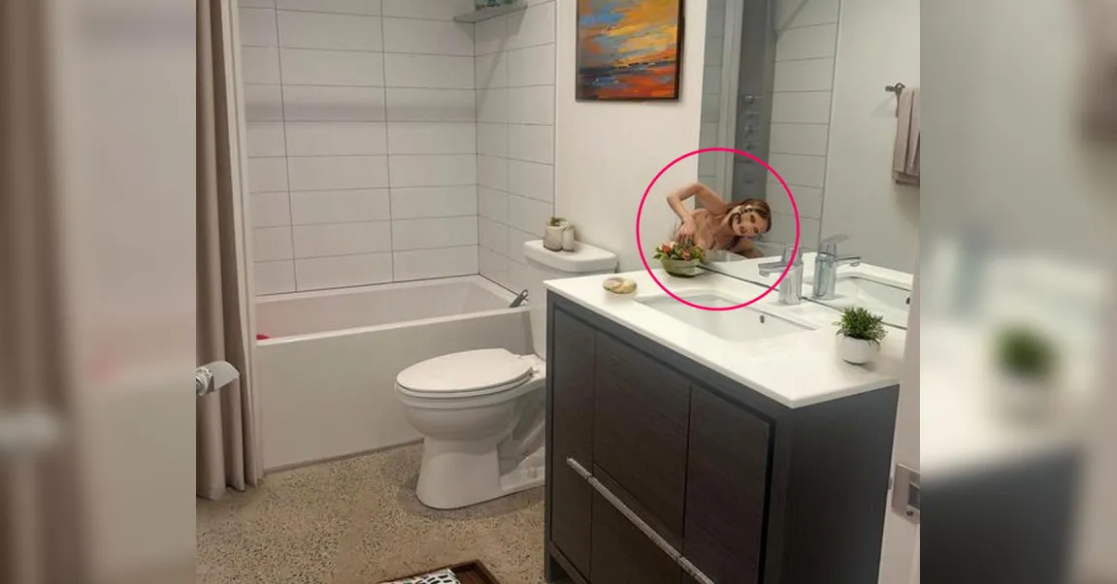
A rental listing in Fort Totten, just north of Washington, DC, briefly featured something no prospective tenant expects to see: a disfigured figure emerging from — and somehow also behind — a bathroom mirror.
The listing has since been scrubbed from Apartments.com. Other versions remain on Redfin, minus the nightmare fuel. The Internet Archive preserved the original for posterity.
One Reddit user called it “genuinely the worst possible thing to scroll past before I fall asleep.” Another described it as their “sleep paralysis demon.”
The image wasn’t just unsettling — it was lazy.
AI Real Estate Fails: The Pattern You’ve Already Seen
This isn’t an isolated incident.
Realtors have been using generative AI to manipulate property photos for months now — smoothing over architectural flaws, rearranging furniture that doesn’t exist, adding trees in impossible locations.
The Fort Totten listing appears to have used AI to remove personal items left on the bathroom vanity. The algorithm also added a mysterious ottoman to the middle of the floor. And the demon.
A separate Reddit user spotted a miniaturized woman crouched on top of a toilet tank in another AI-edited listing — phone in hand, staring into the void.
“How do you not notice the melted demon crawling out of the wall before you hit publish?” one user asked.
The answer: because nobody checked.
The Marketing Problem Nobody Wants to Admit
Here’s what this reveals about professional standards in 2026.
AI tools promise efficiency. They deliver speed. What they don’t deliver — and never promised to deliver — is judgment.
You can spot the tracks of AI everywhere now. The ### placeholders left in blog posts. The *** markers in email copy. The ChatGPT-generated buzzwords that sound like every other listing on the market.
It’s not that AI doesn’t work. It’s that the people deploying it aren’t doing the one thing that separates professionals from amateurs: checking the work.
What You Want Patients (or Clients) to Believe
If you’re a practice owner who’s spent $50K, $100K, maybe more on marketing that didn’t work — agencies that promised results and disappeared, SEO that moved nothing, ads that said the same thing as everyone else — this is the pattern you’ve been burned by.
The problem isn’t the tools. It’s the people who use them without asking the one question that actually matters: What do you want people to believe about your business?
That you’re the most caring? The most advanced? The most experienced?
Once you nail that belief, everything else — ads, content, messaging — exists to prove it.
Your ads aren’t interruptions. They’re evidence.
The Rules Nobody Follows
MLS organizations “consistently prohibit” edits that remove or alter structural elements, erase or modify views, or digitally renovate interiors.
Giraffe360, an AI image editing tool for real estate photos, offers this test: “If an edit would require physical renovation to achieve in real life, it shouldn’t be in an MLS listing photo.”
Whether an Eldritch horror climbing out of a bathroom mirror requires a physical renovation remains unclear.
What is clear: the rules exist, and the professionals posting these listings either don’t know them or don’t care enough to check.
The Bigger Picture: Invisible Expertise
If you’re a healthcare practice owner watching younger competitors dominate Google while you’re invisible — despite having 30 years of documented experience and superior clinical skills — this is the same problem.
It’s not that you’re bad at business. It’s that you got bad advice.
Marketing isn’t about tactics. It’s not about “more content” or “better SEO” or “being on social media.”
It’s about strategy. It’s about working backwards from the destination. It’s about cause and effect thinking.
And it’s about checking the work before it goes live.
The Lazy Marketing Epidemic
The Fort Totten bathroom demon is a symptom — not the disease.
The disease is professionals who’ve outsourced judgment to algorithms that don’t have any.
The disease is agencies that take money, deploy tactics, and disappear without asking what you actually want to accomplish.
The disease is a gap between expertise and market visibility that creates an identity crisis — because the world can’t see what you’re capable of.
And the disease is exhaustion. From trying tactics that don’t work. From running blind with no documented marketing plan. From watching competitors win with inferior skills.
What Separates Professionals From Amateurs
Professionals check the work.
They rip off the band-aid and give it to you straight.
They admit limitations. They share what works and what doesn’t. They don’t overshare, but they don’t hide behind corporate speak either.
And they have no patience for pontificators or know-it-alls who deploy tools without understanding the principles behind them.
AI is a utility. It’s not a replacement for judgment.
The moment you forget that — the moment you hit “publish” without checking — you’re the realtor posting the bathroom demon.
Photo courtesy of: Bright MLS