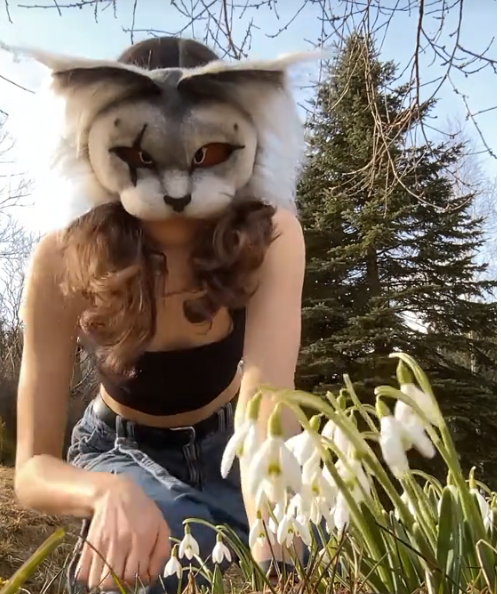
A Buenos Aires plaza turned into an impromptu wildlife preserve last Sunday.
Teenagers in lifelike animal masks ran on all fours across the grass. A 15-year-old named Aguara — who identifies as a Belgian Malinois and counts her age in dog years — leapt through an obstacle course. Others dressed as cats and foxes perched in trees, avoiding eye contact with baffled onlookers.
Welcome to the Argentine therian trend — a viral movement where young people claim to identify mentally, spiritually, or psychologically as non-human animals.
The hashtag #therian has racked up more than 2 million posts on TikTok, with Argentina leading all Latin American countries in engagement. Influencers are weighing in. Media outlets are scrambling to explain it. Parents are somewhere between confused and alarmed. (Picture is from a TikTok video).
And psychologists are now trying to figure out whether this is harmless play — or something else entirely.
What Exactly Is a Therian?
I had no clue that this word even existed. The term “therian” refers to people who say they identify as animals — not in a furry-costume-at-Comic-Con way, but in a deeper, psychological sense. So part human/part animal is what I am going to call it.
Aguara, the self-appointed pack leader with 125,000 TikTok followers, puts it this way: “I wake up like a normal person and live my life like a normal person. I simply have moments when I like being a dog.”
She’s two years and two months old. In dog years.
There’s also a subcategory called “otherpaw” — teens who wear masks and tails or move on all fours just for fun, without claiming to actually be animals. Aru, a 16-year-old in a seal mask, falls into this camp. “It’s not necessarily about identifying as an animal,” she said.
So it’s part identity, part performance, part social experiment — and entirely baffling to anyone over 30.
Why Argentina? Why Now?
Aru credits Argentina’s “fairly free” environment for the trend’s explosive growth.
Translation: TikTok’s algorithm found fertile ground in a country where teens have smartphones, Wi-Fi, and enough cultural flexibility to let this thing take off without immediate adult intervention.
For some participants, the therian part-human/part-animal movement offers something deeper than viral clout — a sense of belonging. A community where they feel accepted. A space where the rules of human social interaction don’t apply.
Which sounds almost poignant until you remember they’re barking at each other in public parks.
Should Parents Be Worried?
Débora Pedace, a psychologist and director of the Integral Therapeutic Center in Buenos Aires, offered the kind of measured response that probably won’t comfort anyone.
“From a psychological standpoint, this is a symbolic identification with an animal,” she said. “It becomes pathological or alarming only when it turns into a deeply rooted belief, and the person fully assumes the role of an animal, potentially leading to self-harm or hurting others.”
So: fine until it’s not.
The line between “harmless teenage experimentation” and “cause for clinical concern” is apparently somewhere between wearing a dog mask on Sundays and forgetting you’re human the rest of the week.
The Bigger Picture: Identity in the TikTok Era
The Argentine therian part-human/part-animal trend isn’t happening in a vacuum.
It’s part of a broader pattern where young people — raised on social media, algorithm-driven content, and the constant pressure to define themselves — are experimenting with identity in increasingly unconventional ways.
Some of it is performance. Some of it is genuine exploration. And some of it is just kids doing weird stuff because the internet told them it was cool.
The difference now is that TikTok turns local oddities into global phenomena overnight. What might have been a handful of teenagers in Buenos Aires five years ago is now a movement with millions of views, international media coverage, and psychologists issuing statements.
What Happens Next?
Hard to say.
Maybe the therian part-human/part-animal trend fades when the next viral movement arrives. Maybe it evolves into something more structured — clubs, conventions, merchandise. Maybe parents start banning TikTok, and the whole thing goes underground.
Or maybe — and this feels like the most likely outcome — it just becomes another data point in the long, strange history of teenagers doing incomprehensible things while adults stand on the sidelines, equal parts horrified and fascinated.
Either way, the dog masks aren’t going anywhere just yet.
Source: AP News – Click On The Link To Check Out Actual Photos