
There’s a new fixture in American parking lots, commercial districts, and public spaces: solar-powered surveillance towers mounted on trailers, bristling with cameras and flashing lights. Police departments call them COWs — “cameras on wheels.” The rest of us might as well call them what they look like: scarecrows for the surveillance age.
They’re not subtle. They’re not trying to be.
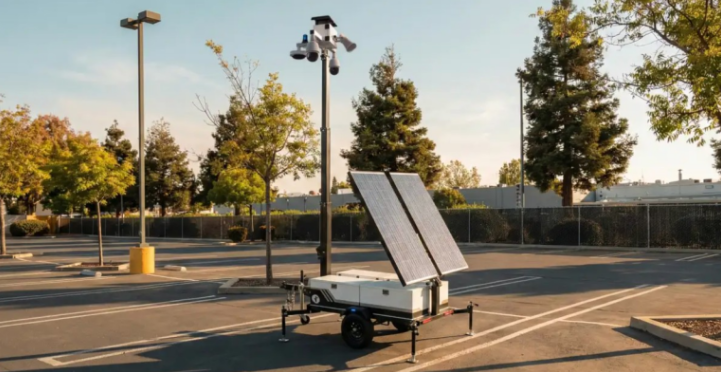
“Sometimes they’re referred to as scarecrows because they have bright flashing lights on them, cameras, and they look kind of scary,” Logan Harris, CEO of military surveillance company Spotter Global, told KTLA. The branding is working — these things look like props from a dystopian film festival, and they’re multiplying faster than anyone can keep up with.
“We Stop Crimes Before They Start”
That line — delivered with a straight face by Nile Coates, vice president of US sales at ECAM — should sound familiar.
In Minority Report (2002), Steven Spielberg’s sci-fi thriller, Tom Cruise plays John Anderton, a law enforcement officer in 2054 Washington, D.C., where “PreCogs” — three psychic humans floating in a pool — predict murders before they happen. The PreCrime unit arrests suspects before they act. Anderton becomes a fugitive when the system predicts he’ll commit a murder. The film was a cautionary tale about surveillance, determinism, and the erosion of civil liberties in the name of safety.
That was fiction. Set 52 years in the future.
We’re in 2026, and police surveillance companies are using the same pitch — minus the psychics, plus AI facial recognition and 150,000 cameras feeding data into third-party servers.
ECAM’s Coates told KTLA: “Our first line of defense is deterrence. We stop crimes before they start. This presence alone reduces risk, and when activity escalates, our team can dispatch directly to local guard partners as well as law enforcement.”
The difference between Minority Report and surveillance scarecrows? In the movie, at least they had the decency to make it look futuristic. In real life, it’s a solar panel on a trailer in a Walmart parking lot.
The Business of Watching You
The law enforcement equipment market hit $11.7 billion in 2025, and surveillance scarecrows are becoming a favorite revenue stream. Companies like Flock Safety and Allied Universal rent or sell these mobile towers to police departments looking to plug gaps in their surveillance networks without the hassle of installing permanent infrastructure.
Here’s what you’re getting: a telescoping CCTV mast, a solar panel, a battery pack, and cellular or Wi-Fi connectivity that pipes footage directly into local police feeds. Add AI-powered facial recognition, and you’ve got a plug-and-play surveillance system that can be dropped anywhere — shopping centers, residential streets, public parks — with zero community input required.
ECAM operates a network of over 150,000 cameras. That’s not a typo. One company. 150,000 cameras. All feeding data into systems designed to identify faces, track movement patterns, and — according to their own marketing — “stop crimes before they start.”
In Minority Report, the PreCrime system was centralized, government-run, and at least theoretically accountable. In 2026 America, it’s privatized, decentralized, and operated by for-profit security contractors with no public oversight.
Progress.
The Surveillance Creep Nobody’s Talking About
These towers don’t just record. They analyze. They track. They feed data to third-party servers, cross-reference faces against databases, and create movement profiles of everyone who passes through their field of view. The AI doesn’t care if you’re committing a crime or buying groceries — it’s logging you either way.
And because they’re mobile, they can be redeployed at will. No public hearing. No warrant. Just a trailer hitch and a new location.
Logan Harris, the Spotter Global CEO, put it plainly: “The market has spoken. It’s been quite amazing how fast this whole market segment has grown. Having that type of video evidence or other sensor data is really helpful.”
Translation: police departments, security contractors, and military agencies are flooding the surveillance industry with cash, and nobody’s asking the uncomfortable questions about what happens when every street corner has a camera tower with facial recognition and a direct line to law enforcement.
The same facial recognition technology that powers these towers already put one woman in jail for five months based on nothing more than an algorithm’s guess and an officer’s visual confirmation. Angela Lipps had never been to Fargo, North Dakota. Her bank statements proved she was somewhere else when the crimes occurred. Didn’t matter — the software flagged her social media photos as a match, and she spent July through December in custody before charges were dropped.
In Spielberg’s film, the PreCrime system eventually collapses under the weight of its own contradictions — false positives, manipulation, and the impossibility of predicting human behavior with certainty. The movie ends with the PreCogs freed and the program shut down.
In real life, the market has spoken. The towers are multiplying. And there’s no third act where anyone shuts this down.
The White House App Wants Your Location, Too
Speaking of uncomfortable surveillance questions — the Trump administration’s White House App, launched in March 2026, was found to contain embedded code that allegedly tracks users’ precise GPS coordinates every 4.5 minutes and syncs them to a third-party server.
A software developer decompiled the app and found OneSignal’s “full GPS pipeline compiled in,” configured to poll location data every 4.5 minutes in the foreground and every 10 minutes in the background. OneSignal is a push notification platform that updates GPS coordinates “approximately every 5 minutes” when location sharing is enabled, which means the White House App was designed to continuously track users’ movements, even when running in the background.
The app also requests access to precise location, biometric fingerprint scanners, the ability to modify or delete shared storage, network connections, and the option to prevent the phone from sleeping. One viral post described it as carrying “China-level big brother permissions.”
The White House promoted the app as delivering “President Donald J. Trump and his Administration directly to the American people like never before” — breaking news alerts, live briefings, a media library, and a direct feedback channel. What they didn’t mention was the continuous GPS surveillance pipeline baked into the code.
In Minority Report, the government at least had the courtesy to tell you they were watching. In 2026, they will just ask you to download an app.
The Pattern Is the Point
Surveillance scarecrows in parking lots. Government apps are tracking your location every few minutes. AI facial recognition is being fed into police databases. These aren’t isolated incidents — they’re the infrastructure of a surveillance state assembling itself in real time.
And the pitch is always the same: safety, deterrence, convenience. The reality is a permanent record of your movements, your face, your habits — collected without your consent, stored indefinitely, and accessible to anyone with the right credentials or a subpoena.
In Minority Report, the PreCrime system was dismantled because it violated the fundamental principle of free will — you can’t punish someone for a crime they haven’t committed yet. The film ends with a question: What kind of society are we willing to become in the name of safety?
We’re getting the answer in real time. Surveillance scarecrows. GPS tracking apps. AI facial recognition. PreCrime without the psychics.
The market has spoken. The question is whether anyone else will.
Photo Courtesy: Flock Safety