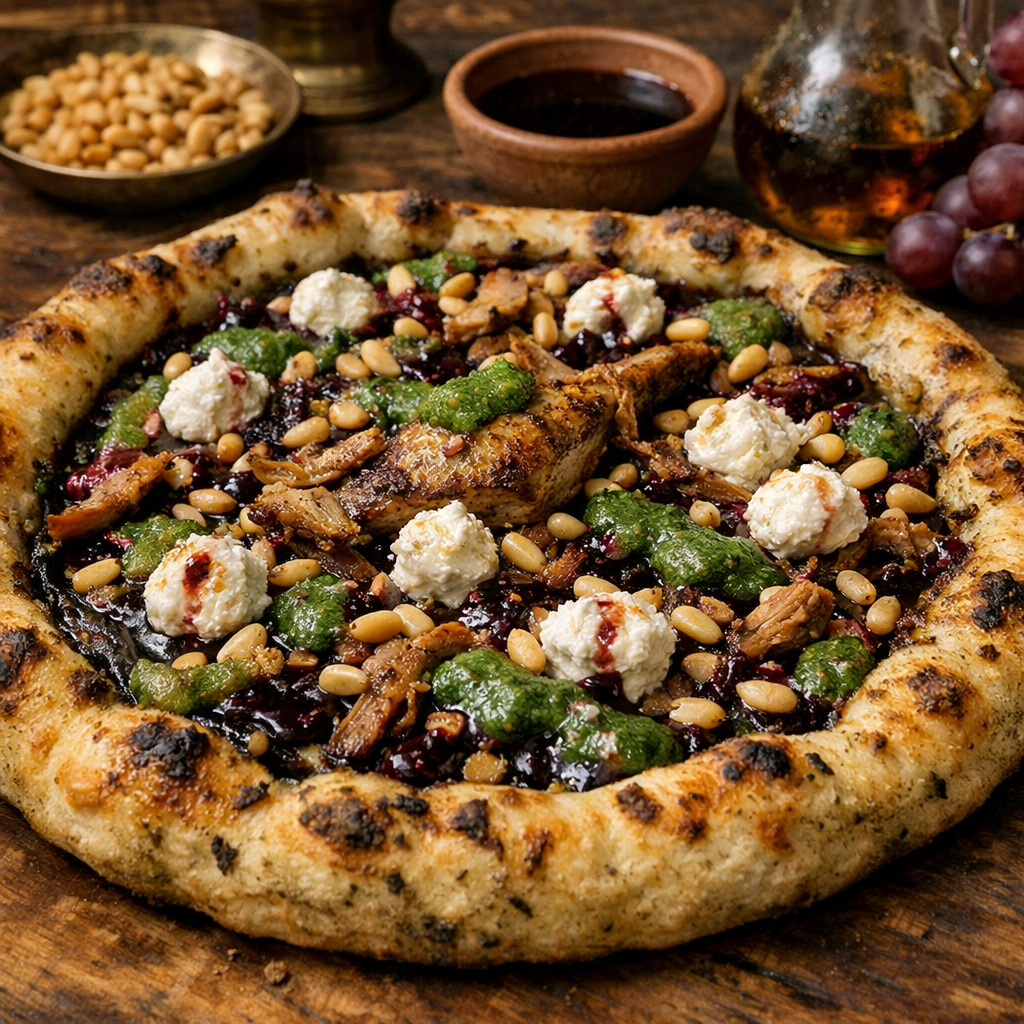
A pizzeria in Budapest just did what most food historians only theorize about — they made pizza the way ancient Romans might have eaten it, which is to say, without anything we’d recognize as pizza.
No tomatoes. No mozzarella. No running water to make the dough rise.
Just fermented spinach juice, fish sauce, and a whole lot of historical commitment. (Yuck)
Neverland Pizzeria’s limited-edition “Roman-era pizza” uses only ingredients available two millennia ago, when flatbreads were sold at snack bars called thermopolia and the word “pizza” didn’t yet exist. The project started after founder Josep Zara saw a 2023 archaeological discovery — a fresco in Pompeii depicting a focaccia-like flatbread topped with pomegranate seeds, dates, and what appeared to be pesto.
“That made me very curious about what kind of flavor this food might have had,” Zara said.
So he consulted a German historian, dug into De re coquinaria (an ancient Roman cookbook from around the 5th century), and handed head chef Gergely Bárdossy a list of historically documented ingredients with one hard rule: nothing from the Americas.
Which meant no tomatoes. No potatoes. No peppers. And definitely no pineapple — though Zara made it clear that boundary still holds in the 21st century too.
The Problem: No Running Water, No Modern Dough
The biggest challenge wasn’t the toppings — it was the base.
“More than 80% of pizza dough is water,” Bárdossy explained. “We had to come up with something that would have worked before running water.”
The solution: fermented spinach juice to help the dough rise. The base itself is made from ancient grains like einkorn and spelt, both widely cultivated in Roman times. The result is denser than modern pizza dough, closer to focaccia, and probably closer to what Romans actually ate.
Then came the toppings — a lineup that reads like a culinary archaeology project:
Epityrum (an olive paste)
Garum (fermented fish sauce, the Roman ketchup)
Confit duck leg
Toasted pine nuts
Ricotta
Grape reduction
“We tried to make it comprehensible for everyone,” Bárdossy said. “Although we wouldn’t use all its ingredients for everyday dishes.”
Translation: this is not a crowd-pleaser. It’s a time-travel experiment that happens to be edible.
Why This Matters (Beyond the Novelty)
Zara’s project isn’t just a gimmick — it’s a reminder that food history is full of gaps we fill in with assumptions. We think of pizza as tomato-mozzarella-basil, but that version didn’t exist until the 1700s in Naples. Before that, flatbreads topped with whatever was available were sold across the Roman Empire, baked in wood-fired ovens and eaten on the go.
The Pompeii fresco that inspired this project suggests Romans were already experimenting with flavor combinations — sweet, savory, herbal — long before anyone thought to call it pizza.
And Zara’s version proves you can make something recognizable as pizza without any of the ingredients we associate with it today. It’s dense, salty, rich, and probably an acquired taste. But it’s also proof that culinary tradition is less fixed than we think.
“Tradition is very important for us,” Zara said. “But we’ve always liked coming up with new and interesting things. These two things together suit us.”
The Verdict: History You Can Eat (If You’re Brave)
The Roman-era pizza is a limited-edition offering, which makes sense — this isn’t the kind of thing you order on a Tuesday night. It’s a niche product for people who care about food archaeology, culinary history, and what ancient Rome tasted like before globalization flattened everything into the same five ingredients.
Bárdossy put it plainly: “There is a narrow niche that thinks this is delicious and is curious about it, while most people want more conventional pizza.”
Fair enough.
But for anyone who’s ever stood in front of a Pompeii fresco and wondered what the food actually tasted like, this is the closest you’re going to get without a time machine.
And no, they still won’t put pineapple on it.