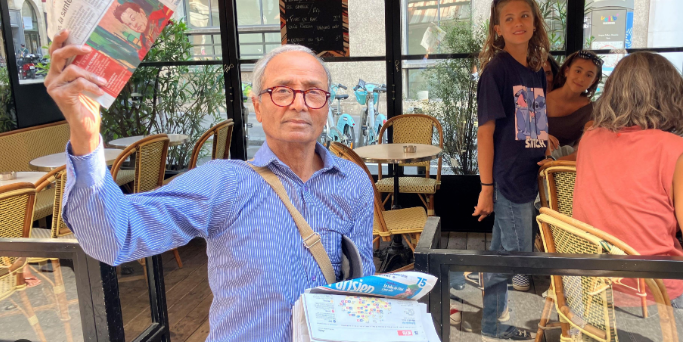
Ali Akbar has been selling newspapers on the streets of Paris for 50 years. Seven days a week. Ten hours a day. Rain or shine. On a secondhand bicycle, weaving between cafés in Saint-Germain-des-Prés, shouting “Ça y est!” — his signature catchphrase meaning “That’s it!”
Last month, French President Emmanuel Macron awarded the 73-year-old Pakistani immigrant one of France’s highest honors — naming him a knight in the National Order of Merit.
The ceremony at the Élysée Palace came with a quiet footnote: Akbar is believed to be the last newspaper hawker left in Paris.
When he finally hangs up his delivery bag, the trade goes with him.
The Voice You Couldn’t Miss
They call him the voice of Paris’ 6th arrondissement — and you hear him before you see him.
For more than five decades, Akbar made the same daily rounds on his bike, delivering fresh stacks of Le Monde and Libération to brasseries across the Left Bank. His customers ranged from neighborhood regulars to Jean-Paul Sartre, Bill Clinton, and, eventually, Emmanuel Macron himself.
“You are the accent of the 6th arrondissement,” Macron told him during the ceremony. “The voice of the French press on Sunday mornings — and every other day of the week.”
Macron went further — calling Akbar “the most French of the French — a Voltairean who arrived from Pakistan.”
High praise for a man who started with nothing.
One Big Dream — Build His Mother a House
Born in Rawalpindi, Pakistan, the oldest of 10 children, Akbar grew up in poverty with one clear goal: make enough money to build his mother a house.
Just before his 18th birthday, he left home — determined to make a better life abroad.
He cleaned floors on a ship in Greece. Picked up the Greek language. Spent time in the Netherlands and Rouen. When he landed in Paris in 1973, an Argentinian friend suggested he start selling newspapers in the Latin Quarter.
One of the first titles he sold was a satirical weekly filled with raunchy cartoons and irreverence toward French politicians. His first thought: “In my country, if you do that, they will kill you.”
He added mainstream dailies and grew to love the work — barely thinking twice about 18-hour days. “Really, those days were paradise for me,” he said.
But paradise came with a price. There were times when he was homeless, choosing to sleep on the streets to save money and send it back to his family. “I was always thinking of my mother and her children,” he said.
Eventually, he fulfilled his dream. Built his mother a house. Settled in a Paris suburb with his wife, Aziza, after an arranged marriage. Raised five sons.
The title of his 2005 memoir says it all: I Make the World Laugh, but the World Makes Me Cry.
The Last of His Kind
These days, Akbar makes about 60 euros — roughly $70 — a day selling papers.
A job that once dotted street corners across Paris has almost vanished — pushed out by the internet and the collapse of print journalism sales. In a city that now gets most of its headlines on phones, Akbar still delivers them by hand.
People in the neighborhood say he’s given them something priceless — a chance for daily human connection. “He’s interested in you, and then you’re interested in him,” longtime customer Michel Mimran said. “And this is very rare now in the big cities.”
Strangers stop him constantly now to congratulate him on the knighthood. For his family, the medal is about healing. “It has put a bandage on old wounds,” his son Shamshad Akbar said.
Macron has reportedly promised Akbar French citizenship — though the Élysée Palace wouldn’t comment when NPR asked.
A Former Detroit Paperboy Remembers
As someone who delivered three different newspapers in the Detroit suburbs, this story hits differently.
The early mornings. The rubber bands. The porch throws. The collection routes on Saturday afternoons. The customers who tipped at Christmas and the ones who never answered the door.
It was a grind — but it was also a job that taught rhythm, reliability, and how to show up when nobody’s watching.
Akbar’s story is the same work ethic, scaled up over 50 years. Same grit. Same loyalty. Same belief that the work matters — even when the world moves on.
Sad to see it go. Sign of the times.
When He Goes, the Trade Goes With Him
On a recent Sunday afternoon, Akbar pushed open the door of a packed brasserie on the Boulevard Saint-Germain. Heads turned. From the back of the room, a small crowd started chanting his name. Then the rest of the place joined in.
“Ali, Ali!” the room sang in unison.
Akbar smiled, lifted his hands — still holding papers — laughed, and shouted in French and English: “Ça y est! I have realized my dream!”
He has no intention of stopping anytime soon. But when he finally does, the newspaper hawker trade in Paris will go with him.
The voice of the 6th arrondissement — silenced.
The last of his kind…
Photo Courtesy of BBC