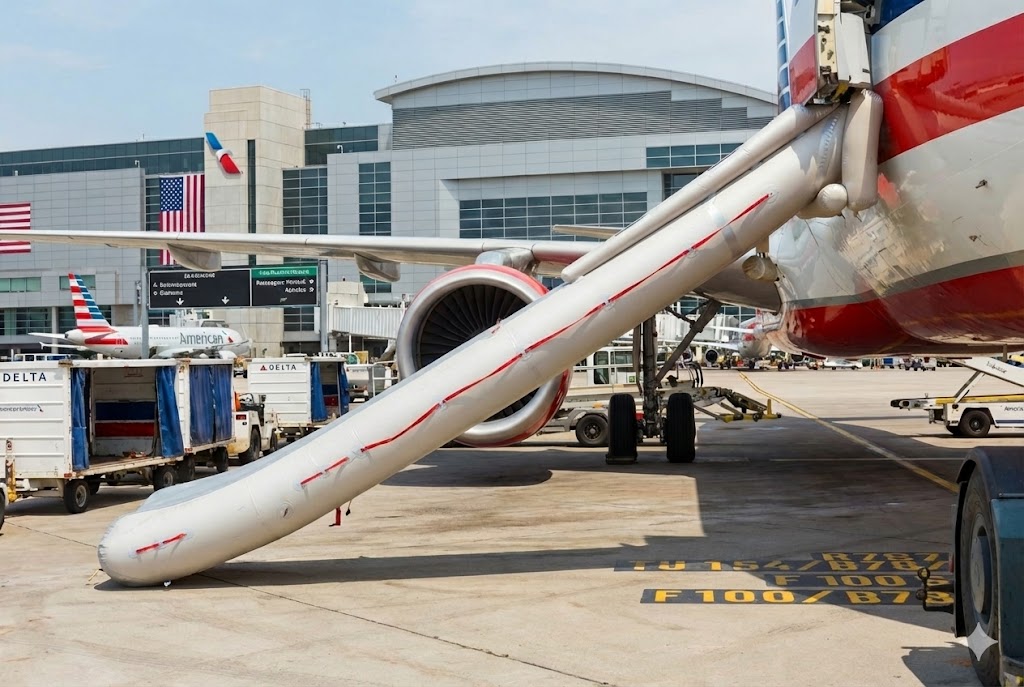
The evacuation slide is deployed. The cabin lights are screaming red. Smoke is doing that low, theatrical crawl along the ceiling. Somewhere up front, a flight attendant is shouting words that should not require interpretation.
And yet — arms go up.
Not in surrender.
In retrieval.
This is the problem now—airplane evacuation bags. People are risking bone, skin, and oxygen flow because the overhead bin contains a backpack with a laptop, a hoodie, and whatever emotional support item made it through TSA.
The priority order has drifted. Badly.
Airlines Are Studying the Human Brain (Because Yelling Didn’t Work)
Airlines have noticed — because of course they have — that passengers keep doing this. Over and over. On video. In real evacuations. Not simulations. Not hypotheticals. Actual moments where speed matters and gravity is not on anyone’s side.
So the industry, through groups like the International Air Transport Association, has decided to bring in psychologists. Not engineers. Not better signage. Psychologists.
That’s where we are.
The thinking is that this isn’t ignorance. Everyone has heard “leave everything behind.” This is instinct. Panic mixed with ownership. A lizard-brain calculation that says: I paid for that bag. I need that bag. I am incomplete without that bag.
Meanwhile, the aisle is blocked.
Ninety Seconds Is Not a Suggestion
Aircraft are certified on the assumption that everyone can get off in about ninety seconds, with half the exits unusable, in darkness, with smoke, and with people who panic differently. That clock does not pause because someone wants their roller bag.
When passengers stop to yank luggage from bins, they slow the line. They knock people over. They snag straps on armrests. They turn a controlled exit into a jam.
Flight attendants know this. They’ve been shouting it for decades. But shouting has limits — especially when someone believes their passport is about to vanish forever.
The math is ugly—delay stacks on delay. People behind you breathe smoke because you wanted your charger.
Ownership, Anxiety, and the Cult of Carry-On
There are reasons people do this, and none of them are flattering. Air travel has trained passengers to distrust the system. Bags get lost. Claims take months. Replacements are expensive. Laptops contain work, photos, and lives.
So when panic hits, the bag becomes a talisman. Proof of continuity. A way to pretend this is still a typical trip with a bad moment, not an emergency requiring obedience and speed.
It’s also a byproduct of how airlines nickel-and-dimed checked luggage into extinction. Everything necessary is in the cabin now. Every overhead bin is a vault.
And when the alarm goes off, people revert to guarding the vault.
The Flight Attendant Is Not Making a Suggestion
There’s a grim irony here. The same passengers who won’t listen during evacuations are hyper-alert during boarding. They know bin etiquette. They know when to stand. They know how to wedge a bag sideways.
But in emergencies, authority collapses. Instructions become optional. The uniform turns into background noise.
That’s why airlines are considering design changes — bins that lock automatically, lighting that directs attention downward, messaging that bypasses logic and goes straight for reflex.
Because reason has left the cabin.
This Isn’t About Intelligence
It’s tempting to call this stupidity. It isn’t. It’s conditioning. Years of scarcity thinking reinforced by customer-hostile systems.
The bag feels permanent. The danger feels abstract until it isn’t.
Psychologists can map this. They can explain it. They might even fix it. Or they might confirm what everyone already knows: stress turns adults into toddlers clutching toys.
Except that the toys weigh forty pounds and block exits.
The Uncomfortable Part
No one thinks they would do this. Everyone imagines themselves calm, decisive, empty-handed, gliding heroically down the slide.
Reality footage says otherwise.
People grab bags because the plane still feels like a plane — not a threat — until the moment it very much is. By then, habits have taken over. Muscle memory beats announcements.
The airlines can study it. The psychologists can diagram it. The safety videos can get louder.
But until the instinct shifts, the overhead bin will keep winning arguments it shouldn’t be part of.
End of Briefing
Fire doesn’t care about your laptop. Smoke doesn’t respect sunk costs. Slides don’t wait.
And the next time the cabin crew says leave everything, they’re not asking you to be noble. They’re asking you to move…