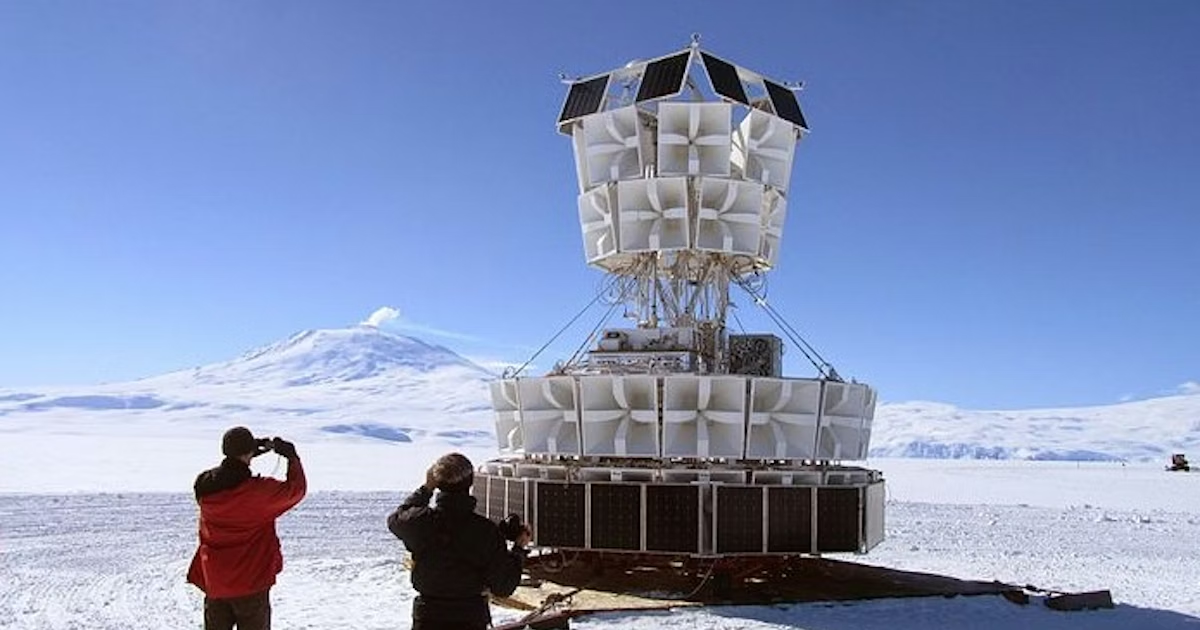
The weird stories never announce themselves. They just stroll in, flick the lights twice, and act like Antarctica is the logical place for answers. The ANITA saga fits right in — a cosmic prank hiding under a few miles of ice, radio static, and scientists giving that tight-lipped “everything’s normal” smile even as the universe taps them on the forehead like, hey man, you seeing this?
ANITA — the Antarctic Impulsive Transient Antenna — is a big balloon full of antennas drifting over the South Pole listening for cosmic rays. Straightforward mission. Nothing spooky. It’s basically the world’s coldest, loneliest radio intern.
Except then it heard something coming up from under the ice.
Up. Through thousands of kilometers of rock. Like the universe took the manual, threw it in the shredder, and said, “Try explaining this, nerds.”
Scientists expected radio pulses from cosmic rays slamming into the atmosphere. Instead, they got upward-moving signals—at angles steep enough to make every neutrino physicist reach for the good aspirin. These pulses behaved like tau neutrinos punching through the planet… except neutrinos at those energies shouldn’t survive that trip unless they’re training for the subatomic Olympics.
And here’s the fun part: nobody else sees them. Not Pierre Auger, not Ice Cube, not any observatory with a name that sounds like a 1970s prog-rock band. Just ANITA, floating over Antarctica like a confused satellite dish begging for an explanation.
This is where the media jumps in with their favorite phrase: “Could this be new physics?” Which is always the polite way of saying, “We don’t know what the hell is going on, but if we say ‘ALIENS’ everyone gets mad.”
Researchers have tried the usual suspects. Tau neutrinos? Doesn’t match the models. Exotic dark-matter particles? Fun theory, but not supported by anything else. Maybe the ice is bending the radio waves in some strange way? Sure, maybe the ice sheet developed a sense of humor.
And then there’s the Standard Model of physics — our big rulebook for how particles behave. These ANITA events treat that rulebook like my dog treats a new pair of shoes.
The scientists are building a new detector called PUEO to figure out whether this mystery is real or just Antarctica messing with us. It’s basically ANITA with more attitude, more antennas, and probably the same amount of confusion.
But here’s the thing nobody wants to say out loud: science needs weird stories like this. These anomalies are reminders that we haven’t cracked the universe. We’re nowhere close. Every so often, nature nudges us and goes, “Hey, notice this glitch? Good. You’re welcome.”
And the most honest reaction is exactly what every researcher secretly feels when a signal pops up from under the ice:
“…Well that’s not supposed to happen.”
If it turns out to be new physics, wonderful. If it’s dark matter doing its best impression of a neutrino, great. If it’s the ice being chaotic and unhelpful, also fine. Either way, it’s a rare moment where the universe waves a flag and says it still has secrets.
And that’s why this story sticks with me. Not because of aliens or anomalies, but because it reminds us that even the most confident fields — particle physics, astrophysics, cosmology — still get blindsided. The universe isn’t done surprising us.
Besides, if you’re going to get humbled, better it happens in Antarctica. No one can see you blush under all that ice.