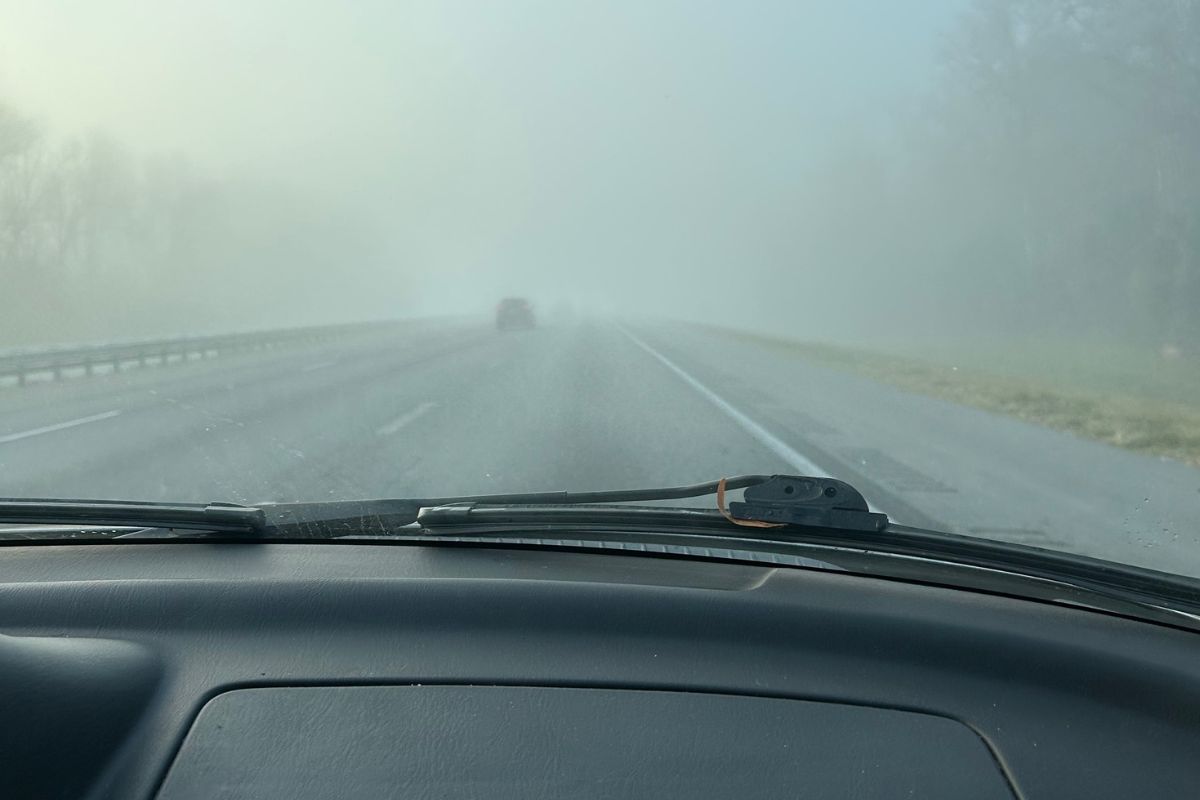
The week started with fog.
Not the poetic kind. The kind that shuts down visibility, slows traffic to a crawl, and earns an official warning. “Radiation fog,” the alerts said, which immediately did what that phrase always does — it set off a small internal alarm before the brain caught up.

Radiation fog, in weather terms, is ordinary enough. It forms overnight when the ground cools, the air near the surface follows, and moisture condenses into a low blanket that sits until the sun burns it off. It’s common. It’s seasonal. It’s been around longer than headlines. But the warnings were widespread this time, stretching across multiple states, and the fog itself moved steadily west to east, thick enough in places to drop visibility to a quarter mile or less.
Then, two days later, a very specific airplane showed up.
People who track aircraft noticed it first. A Boeing WC-135R Constant Phoenix — the US Air Force plane designed to sample the atmosphere for radioactive debris — lifted off from Nebraska and began looping across South Dakota, near Fargo, and around Rapid City. Not transiting cleanly from point A to point B. Circling. Sampling patterns. Lingering.

On its own, that flight is explainable. The Constant Phoenix flies domestic missions for training, calibration, and background radiation monitoring. It has done so for decades. It’s the only aircraft in the US fleet built specifically to detect radioactive clouds, but that doesn’t mean it’s only used when something has gone wrong. Sometimes it flies because it has to stay ready.
On its own, the fog was explainable too.
What made people uneasy was the alignment.
A radiation fog alert stretches across the country. A plane whose job is to sniff radioactive particles flying over the same broad corridor. The fog moving east. The jet moving east. Two stories, two days apart, sharing the same vocabulary and roughly the same geography.
Coincidence doesn’t mean impossible. It just means unsatisfying.
There were other background details that week that didn’t help. The New START nuclear treaty between the US and Russia is approaching expiration. A redesigned intercontinental ballistic missile target vehicle was tested the same day as the WC-135R flight. None of that proves linkage, but context accumulates whether anyone wants it to or not.
Officially, there’s no confirmation that the flight was connected to anything unusual. And it may not have been. These aircraft routinely collect baseline atmospheric data. They fly domestic routes. They’ve done it quietly for years. The fog itself wasn’t radioactive in the dangerous sense — just meteorology doing what it always does when nights are calm and moist.
Still, it’s hard to ignore how the human brain works when inputs stack.
The word “radiation” appears in a weather alert. Two days later, a radiation-detecting aircraft appears in the sky. Flight paths get posted. Screenshots circulate. The cloud moves east. The jet loops east. Nothing definitive connects them, but nothing separates them cleanly either, at least not in the public explanation.
This is the part where a cleaner narrative would usually arrive. An official statement. A tidy dismissal. A quote that closes the loop.
That didn’t happen.
Instead, what we got was silence, historical footnotes, and reassurance by familiarity. The Constant Phoenix has flown since 1947. It tracked fallout from Chernobyl. It samples air the way weather balloons sample pressure. This is all true. It’s also true that most people never notice the plane at all — until a week like this, when the word “radiation” is already sitting at the front of their mind.
The fog eventually lifted, as fog always does. Roads cleared. Advisories expired. But the timing lingered longer than the mist itself.
Nothing about this requires panic. Nothing here proves contamination, fallout, or a hidden event. But it does illustrate how fragile public calm becomes when technical language, military hardware, and poor communication overlap.
The atmosphere didn’t change this week. The aircraft didn’t either. What changed was the way those two things crossed the public’s field of view at the same moment.
Sometimes that’s all it takes to turn routine systems into a mystery — not because something happened, but because no one bothered to say clearly that nothing did.