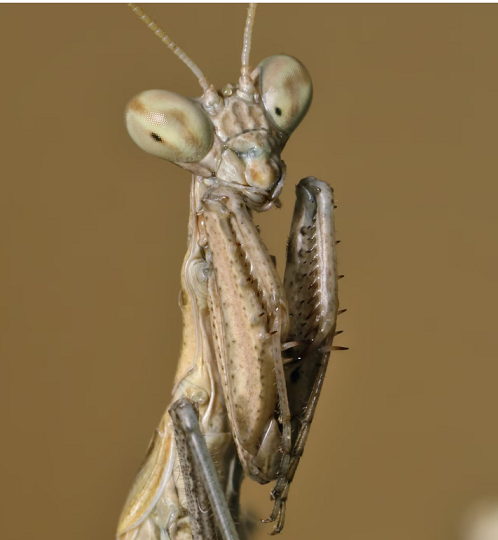
I was reading about a newly discovered praying mantis the other day — the kind of thing you stumble on while pretending you’re just “checking the news” — and it turns out one species has solved one of nature’s more awkward problems.
Specifically: how not to get eaten immediately after sex.
The snake-tail mantis, Ameles serpentiscauda, is a newly identified dwarf mantis species that avoids post-coital decapitation by performing an elaborate dance. Not a metaphorical one. A literal, body-writhing, snake-impression routine performed inches from a female who is famously bad at impulse control.
Romance, mantis-style.
The Reputation Problem
Praying mantises have branding issues. When most people hear “mantis,” they picture a big green insect calmly chewing its mate’s head off like it’s finishing a sandwich. Which, to be fair, does happen. Often. Sometimes mid-act. No apologies offered.
But mantises are more complicated than their worst PR moments — like airlines, tech companies, and anyone who says “we value transparency.”
There are roughly 2,500 known mantis species worldwide, many of them small, strange, and deeply committed to not being noticed. Leaves, sticks, moss, flowers — they cosplay as all of it. Masters of disguise. Olympic-level hiders.
Behavior-wise, though, we barely know what they’re up to mainly because they’re very good at vanishing right when you’re trying to study them. Naturally.
Enter the Snake-Tail Mantis
The snake-tail mantis was discovered more or less by accident in the summer of 2024, when researchers spotted some tiny mantises on shrubs near a beach in Sardinia. At first glance, they looked like a known dwarf species — same general vibe, same size, same “don’t mind me” energy.
But the wings were wrong. Too small. Non-functional. Decorative, at best.
Then they watched them mate.
That’s when things got weird.
The Dance That Saves Your Life
Male snake-tail mantises don’t just approach a female and hope for the best — a strategy that historically ends poorly. Instead, they perform a courtship display that looks like something halfway between interpretive dance and a warning label.
The abdomen moves sinuously, like a snake sliding through grass. Then it snaps sharply, rattlesnake-style, all jerky motion and sudden stops. It’s hypnotic. Distracting. Possibly confusing enough to keep the female from doing what female mantises so often do.
Which is murder.
Researchers believe this dance evolved as a communication strategy — a visual “please don’t eat me” message delivered in fluent mantis. Each dwarf mantis species, it turns out, has its own love language. Some wave limbs. Some sway. This one goes full serpent.
Overachiever.
A Species Hiding in Plain Sight
What finally confirmed this mantis as a new species wasn’t its size or its wings — it was the performance.
That’s the thing about insect behavior: it’s easy to underestimate until it suddenly isn’t. These animals are primarily solitary, mostly silent, and mostly invisible. Yet somehow they’ve evolved particular, ritualized communication systems that only make sense if you’re paying very close attention.
Almost no one was until now.
And that’s how a one-inch-long insect, doing a frantic little dance on a Mediterranean shrub, ended up rewriting what we thought we knew about mantis romance.
Survive mating.
Invent choreography.
Disappear again.
Evolution is efficient like that…
photo courtesy: National Geographic/Roberto Scherini