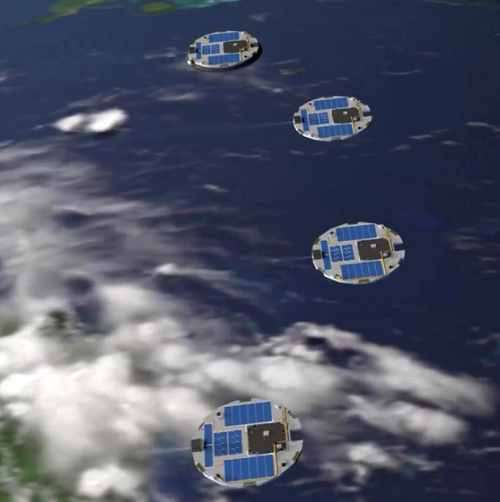
I was reading a local Montana news blurb—one of those quiet, under-the-radar stories sandwiched between weather alerts and city council drama—when NASA casually mentioned it had launched four disk-shaped satellites into low Earth orbit. Disk-shaped. Not cylindrical. Not boxy. Disks. Flying saucer adjacent. Naturally.
They’re called DiskSats, which sounds like something you’d buy at a museum gift shop right before realizing it costs $49.95 and doesn’t do anything. Except these actually do things. Serious things. Orbital things. Science things.
And they look exactly like what people have been sketching on bar napkins since 1947.
A Flying Saucer, But With a Press Release
NASA insists there’s nothing alien about this. These disk-shaped satellites were designed for efficiency—more surface area for instruments, better thermal control, and maneuverability that traditional cube or tube satellites can’t manage. Which is all very reasonable. Sensible, even.
Still.
You don’t accidentally design a spacecraft that looks like a UFO. Somewhere along the line, someone signed off on a blueprint and said, “Yes, this will absolutely not cause questions.” Right on cue.
The DiskSats are meant for low-orbit missions, where space is crowded, budgets are tight, and every square inch of surface matters. The circular shape allows solar panels, sensors, and antennas to spread out instead of stacking vertically like a junk drawer of electronics. Practical. Efficient. Mildly unsettling.
The Problem With Making Spacecraft Look Like UFOs
Here’s the thing about Weird Science—it never announces itself. It just shows up looking suspiciously like something from a 1950s drive-in movie and waits for us to notice.
NASA frames this as innovation. Engineers talk about drag reduction, orientation control, and modular payloads. All true. All valid. All beside the point.
Because the public sees a flying saucer. A clean, symmetrical disk quietly orbiting Earth, reflecting sunlight at odd hours, triggering a thousand blurry phone videos captioned “ANYONE ELSE SEE THIS???” Total madness.
And NASA knows this. They absolutely know this. You don’t name it DiskSat unless you’re leaning into the bit—just a little.
Low Earth Orbit Is Getting Weird
Low Earth orbit used to be a sparse neighborhood. A few satellites. A space station. The occasional Cold War relic tumbling endlessly. Now it’s a traffic jam. CubeSats, Starlink chains, experimental platforms, space junk with commitment issues.
Disk-shaped satellites are NASA’s way of adapting—rethinking form instead of endlessly shrinking function. Flat, wide, efficient. Designed to cooperate with physics rather than bully it. The math checks out.
Still, the aesthetic choice is doing a lot of work here.
Science Fiction, Accidentally Fulfilled
Officials say these satellites could “change how small spacecraft operate.” Which is usually code for “this will quietly become normal in ten years and no one will remember why it felt strange.” But for now, we’re in the fun phase—the phase where science fiction and government engineering overlap just enough to make people squint at the sky.
Flying saucers are no longer hypothetical. They’re federally funded. Peer-reviewed. Launched on schedule.
And somewhere out there, four perfect little disks are circling the planet, gathering data, minding their business, and absolutely not helping the UFO discourse at all.
photo courtesy: NASA