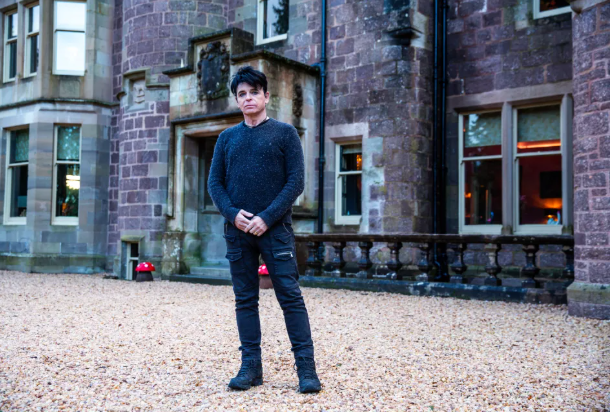
Gary Numan has spent a career making machines sound emotional. He turned static and circuitry into art. But now, tucked away in the Scottish Highlands, it’s the silence that’s making him uneasy.
The 67-year-old pop icon—whose hits Cars and Are “Friends” Electric? still echo through every synth-pop revival—has reportedly barricaded himself in his bedroom at a 19th-century, 12-bedroom castle in the Trossachs after what he describes as “unsettling” activity. Whispering voices. Doors that slam on their own. Footsteps that stop right outside the door. Even his daughters, according to The Scottish Sun, have heard the same things.
Here is the video of “Cars”
You can almost hear the headline writing itself: Rock Star Haunted by His Own Echoes.
But this isn’t some attention grab. Numan’s always been an honest interview—open about anxiety, perfectionism, the weight of his own fame. Which makes this story weirder. Here’s a guy who built his identity on technology and control suddenly saying, something else is running the show.
And yes, he’s called in professionals—psychic Ian Lawman and paranormal investigator Katrina Weidman. Their team scoured the place with cameras, EMF readers, and the sort of skeptical optimism that sells well on streaming platforms. The verdict? Spirits in residence. One reportedly that of a young girl in the basement. Others “less defined.”
Now, that could all sound like classic ghost-hunter theater—if not for how genuinely shaken Numan appears. He’s not filming a Halloween special. He’s just trying to live in his house. Or at least, in one room of it.
The Soundtrack of Isolation
Numan’s life has always been tied to isolation. Early fame nearly broke him. The tabloids called him “the coldest man in pop,” mistaking shyness for arrogance. Decades later, he admitted in interviews that the stage confidence was armor. “I used to think fame would make me happy,” he once told The Guardian. “It made me miserable.”
So now picture that same man in a cavernous Scottish castle—stone walls, heavy drapes, the kind of place built to keep the world out. Add in long nights, the wind rolling off the loch, maybe a creak or two. It’s not hard to see how the mind might start filling in blanks. Every sound becomes a story.
Numan’s home isn’t just a house—it’s a symbol. The fortress you retreat to when fame feels invasive can also become your prison when quiet turns on you.
The Ghost Economy
Haunted houses are big business in Britain. Ghost tourism brings millions into rural towns. Old manors are practically required to come with a good haunting or two—it’s half history, half marketing. The Trossachs, where Numan’s estate sits, are particularly loaded with folklore. Ancient burial sites, tragic Victorian tales, battlefields that supposedly never went quiet.
Even the castle itself (Numan hasn’t made the name public, wisely) has likely changed hands dozens of times since it was built in the 1800s. You don’t get a structure like that without layers of story—servants’ quarters, locked wings, family portraits that seem to follow you down the hall. Over time, those stories ferment. Give them a famous owner, and suddenly the ghosts have an audience.
There’s a strange feedback loop here: celebrity attention fuels folklore, folklore fuels media attention, and before you know it, the story has its own life. Whether you believe in ghosts or not, the cultural machinery around them is very real.
The Paranormal Meets Pop Culture
What’s fascinating about the Numan case is that it bridges two types of superstition—rock mythology and the supernatural. Fans have always wanted their idols to live on the edge of mystery. Bowie and the occult. Ozzy and the bats. Stevie Nicks and witchcraft whispers. It’s part of the storytelling around fame.
Numan, though, isn’t playing a character. He’s a family man in his sixties, raising daughters, working on new music, and trying to keep his sanity in a castle that apparently has other residents. Which somehow makes it more believable.
He told one interviewer years ago that fame had left him “feeling haunted.” Different ghosts, same idea. Maybe he just finally met them in person.
Science, Skepticism, and the Human Need for a Story
Skeptics will say the old pipes are groaning, the temperature shifts are creating auditory illusions, and that centuries-old buildings have a knack for messing with perception. All true. But the psychology of haunting is less about evidence and more about belief.
When you’ve lived in noise—tour buses, studios, screaming crowds—sudden silence can be deafening. The human brain doesn’t like empty space. It fills it with narrative. For some, that’s music. For others, ghosts.
Maybe the haunting isn’t a curse. Maybe it’s just the price of reflection—the past echoing through stone halls. When you’ve spent decades running from one version of yourself to the next, sitting still in a castle might be the scariest thing imaginable.
Why This Story Resonates
It’s not just about celebrity weirdness. It’s about how we project meaning onto place. Every home holds a kind of emotional residue. For most of us, that’s memories and regrets. For Gary Numan, it’s apparently a whispering child in the basement.
But peel back the sensational headlines, and there’s something poetic about it. Here’s a man who made electronic music feel human, now confronting the most ancient form of humanity’s fear—the unknown in the dark. You couldn’t script it better.
If he turns this into a concept album, I won’t be surprised. Ghosts in the Machine practically writes itself.
Closing Thought
Fame changes your relationship with the world. The house gets bigger, the crowds get louder, and eventually the only quiet you can afford comes with its own set of ghosts.
Numan might not ever find out what’s haunting his castle. But he’s given us one of the most fitting metaphors for a pop star’s second act: the music fades, the echoes remain, and even the silence won’t leave you alone.
photo credit: Discovery+ UK