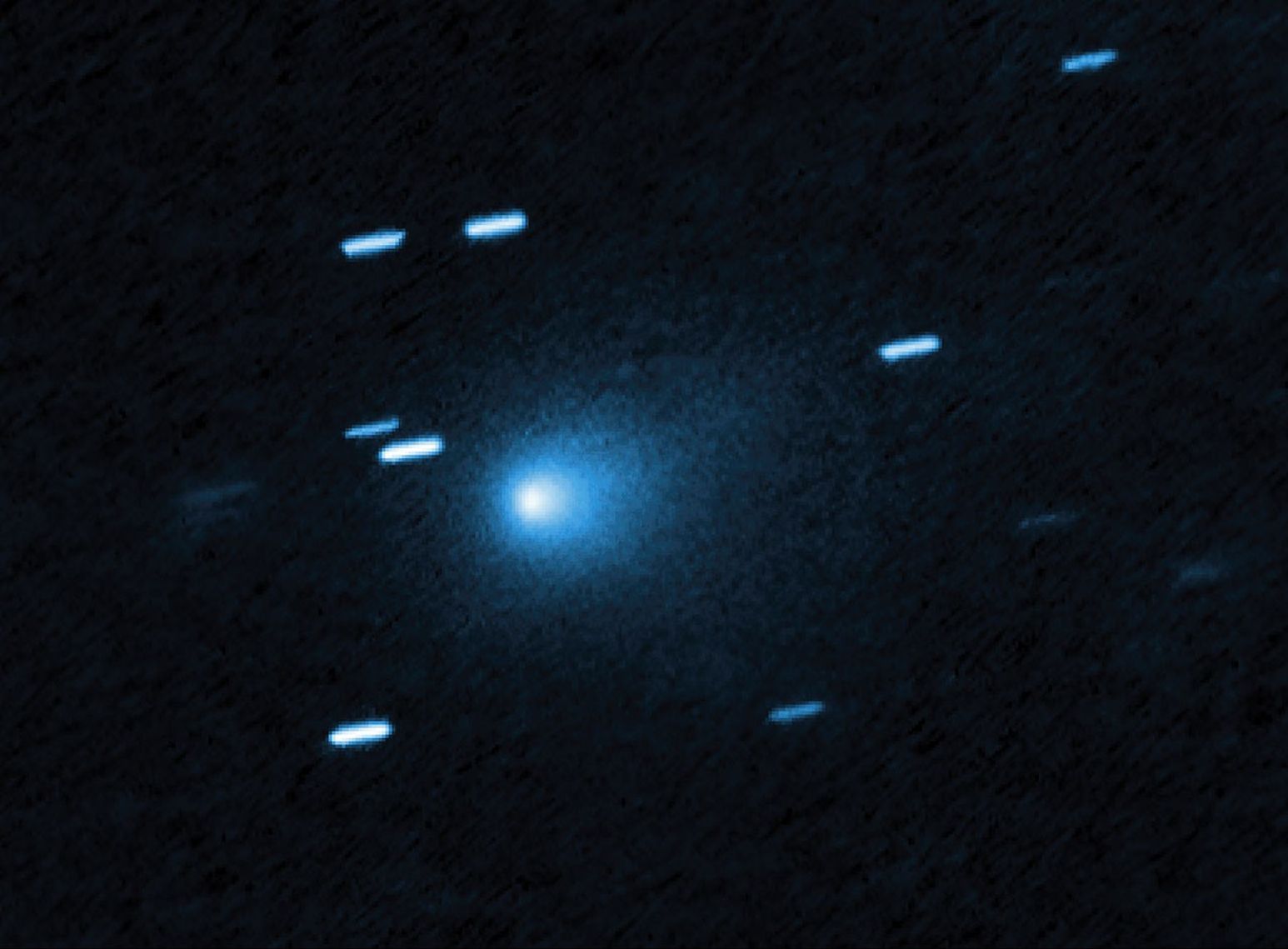
I was reading a ClickOrlando story about an interstellar comet making its “closest approach” to Earth. I immediately felt the cultural muscle memory kick in — the part of our brain trained by late-90s disaster movies to assume this ends with fire, sacrifice, and someone hugging their daughter under a glowing sky.
It does not.
Instead, the interstellar comet did the most responsible thing imaginable. It passed through. It kept its distance. It didn’t touch anything. And then it left.
No impact. No panic. No Bruce Willis. Just a quiet cosmic drive-by from another star system that behaved better than most people in a grocery store parking lot.
Which, honestly, feels worth noting.
“Closest Approach” Is Space for “Not Close at All”
The phrase closest approach sounds loaded — ominous, even — until you realize that in space math, it still means hundreds of millions of miles away. That’s not flirting with disaster. That’s waving from another ZIP code.
But headlines don’t live on nuance. They live on implication — the gentle suggestion that something almost happened, even when nothing remotely did.
So we get stories that technically aren’t wrong but emotionally feel like a tease. The comet didn’t threaten Earth. It didn’t alter orbits. It didn’t even inconvenience satellites. It just passed by, minding its business, while humans collectively leaned forward expecting a jump scare that never came.
Disappointing. Calming. Very on-brand for reality.
A Visitor From Somewhere Else
What is legitimately interesting — and easy to miss once the hype machine spins up — is that this object isn’t from around here. This interstellar comet formed around a completely different star, billions of years ago, and somehow wandered into our solar system like a traveler who refuses to check bags or explain their itinerary.
That doesn’t happen often.
In fact, this marks only the third confirmed time we’ve ever spotted something interstellar passing through our cosmic neighborhood. Three. Ever. And none of them tried to kill us, despite the expectations we keep projecting onto them.
The first was ʻOumuamua in 2017 — the oddly shaped object that inspired more alien speculation than a season of The X-Files. It wasn’t a comet. It wasn’t quite an asteroid. It didn’t behave the way scientists expected. And it passed closer to the Sun than Earth before quietly exiting the solar system without clarifying anything.
Naturally, this drove people insane.
It didn’t hit Earth. It didn’t change life as we know it. It just showed up, confused everyone, and left — which might be the most realistic visitor story imaginable.
Then came 2I/Borisov in 2019, the first confirmed interstellar comet. This one looked the part — glowing coma, trailing dust, the full comet aesthetic — and still managed to pass through without incident. Astronomers studied it. Headlines flared. Humanity survived.
Again.
Now we have this latest interstellar comet, and once more the pattern holds. The science is fascinating. The risk is nonexistent. The reaction is… a bit much.
The Comet With Boundaries
What stands out most isn’t what the interstellar comet did — it’s what it didn’t do.
It didn’t wander too close.
It didn’t demand attention.
It didn’t force a reckoning.
It respected boundaries.
In a year where everything else feels uncomfortably close — news, noise, outrage, opinions — a rock from another star system managed to swing by and demonstrate restraint. Show up briefly. Be interesting. Leave without wreckage.
That’s growth. Cosmic growth.
And yet, we still framed it like a near miss, like the universe almost knocked over the lamp but caught itself at the last second. It didn’t. It was never going to. We just like our space stories the same way we want our weather alerts — dramatic enough to feel alive.
No Armageddon. No Impact. No Scene.
Something is revealing about how badly we wanted this to be bigger than it was. Safer isn’t satisfying. Normal doesn’t trend. A comet that behaves responsibly doesn’t scratch the itch.
But that’s the truth of it. The interstellar comet passed Earth at a distance so large it barely counts as a flyby, carried on its ancient trajectory, and left us exactly as it found us — intact, unharmed, and still refreshing headlines for the next thing to worry about.
No Armageddon.
No Deep Impact.
Just a cosmic visitor with manners.